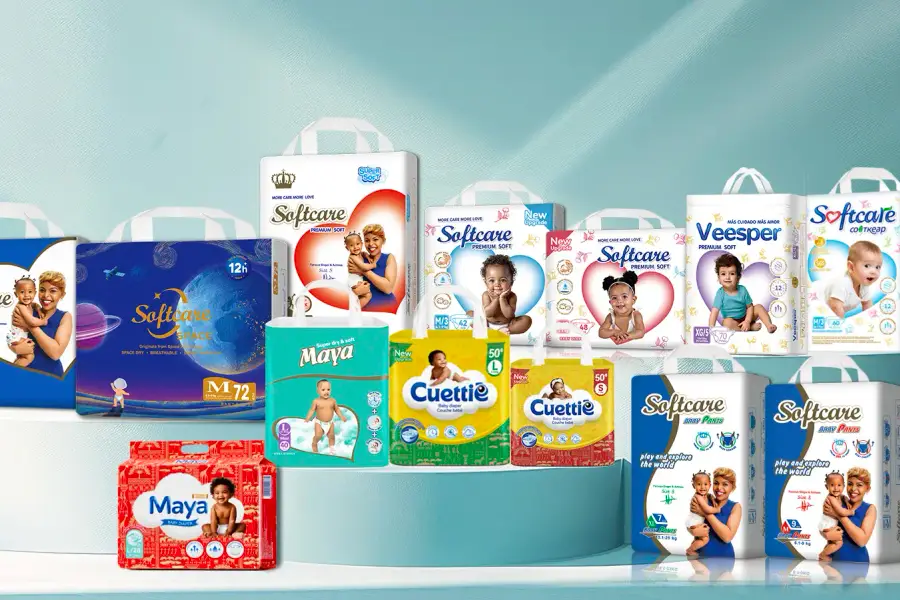
Softcare’s revenue rose by 25% last year, while its profit increased 27%, as its focus on emerging markets yielded solid results
Key Takeaways:
- Softcare reported 25% revenue growth last year, led by a 134% rise in Latin America and double-digit growth in its core African markets
- The strong results put the diaper maker at the front of the pack of a new wave of Chinese companies chasing African consumers
By Edith Terry
The company known as the “African diaper king” has defied skeptics who said it couldn’t sustain its dominant position in its core Africa market, as well as other emerging markets it has entered more recently. Many of the new believers in Softcare Ltd. (2698.HK) cheered the release of the company’s inaugural annual results late last week by bidding up its shares nearly 15% in the two trading days after the announcement.
The company’s revenue rose by 24.9% year-over-year to $567 million last year, while its net profit was up 27.4% to $121 million. Its gross profit margin also rose from 35.2% in 2024 to 35.9% in 2025, another positive indicator.
Sales to its core markets in Africa rose by a healthy 22.5% to $545 million. The company is also moving out of Africa to find success in other emerging markets. The best example is Latin America, whose sales more than doubled to $22 million, just five years after it entered Peru in 2020, and added El Salvador in 2024. The company is also building a presence in Central Asia, where its sales, though quite small, more than doubled last year to $272,000.
After several years of declines, average selling prices (ASP) for Softcare’s two largest product lines rose between 4% and 7% last year, according to the results announcement. Baby diaper ASPs increased by 4.4% year-over-year, as that segment accounted for 78.6% of total revenue. Feminine hygiene product ASPs grew by 7% and made up 17.5% of revenue.
The ASP increases are important because they show the company is finding ways to convince consumers to pay more for its products in these famously price-sensitive markets, helping to maintain and even boost its margins. In a previous prospectus before its November IPO last year, the company reported its profit growth slowed to 54.1% in the first three quarters of 2024 from explosive 252% growth in 2023. A later filing showed the profit growth slowed further still to just 12% in the first four months of 2025, sparking concerns that its low-price strategy was undermining its ability to grow profitably.
The skeptics argued that Softcare was falling into the same trap in Africa and other emerging markets that has tripped up budget cellphone maker Transsion (688036.SS) in the last few years. Transsion, another Chinese company that found big success in Africa, taking more than half of the market, saw its revenue and profit flatline and even decline in 2024 and 2025.
Price wars and increasing component costs squeezed Transsion as it also faced competition from other Chinese brands, including Xiaomi, Realme and Honor, which came later to the market. Analysts said Softcare would face the similar pressures as Africa became the frontier market of choice for a new wave of Chinese consumer brands.
At least for now, Softcare’s return to accelerating profit growth and improving margins seem to be quieting the skeptics. That could change, however, if competitors like Haoyue Personal Care (605009.SS), Soft International (2569.HK), Lantian Group, decide to cultivate the African market.
Sinolink Securities estimates the African personal care market was worth $3.8 billion in 2024 and will rise to $10 billion in the longer term. It bases its bullish outlook on Africa’s high birthrate, around 4%, and low penetration rates of 20% to 30% for key products like baby diapers and sanitary napkins, compared to 70% to 90% in mature markets in Europe and the U.S.
Youthful demographics
Africa’s youthful demographics and fast-growing cities make it attractive to Chinese consumer brands that can leverage their low-cost advantages. Such price-sensitive markets are relatively neglected by big Western consumer companies like Pampers maker Procter & Gamble (PG.US) and Huggies maker Kimberly-Clark (KMB.US), making them fertile ground for Chinese manufacturers like Softcare. Pampers and Huggies both focus on the relatively affluent South Africa market, which Softcare so far has ignored in favor of less affluent markets in East, Central and West Africa.
The race to Africa is reflected in recent trade flows. Overall, China’s exports rose by 21.8% in January and February to $657 billion, with exports to Africa up by 50% and Latin America up by 16.4%. Softcare is among the early movers in the new African wave. Its founder, Shen Yanchang, went to Nigeria at the age of 24 in 1997 on the advice of his father. He worked there as a purchasing manager for a Hong Kong-funded company that produced steel, enamelware and hardware products.
He returned to his home in the Northeastern city of Harbin two years later after contracting malaria, and a supplier in Nigeria asked him to source $200,000 worth of Chinese products. Shen turned that into an opportunity and began supplying jeans, non-woven fabrics and electrical components to African buyers. Shen and girlfriend, later wife, Yang Yanjuan continued that work with their registration of a trading company in 2000.
Their company entered the baby products business in 2009 with the launch of its Softcare diapers in Ghana. By 2018, the company began localized manufacturing of diapers, pull-up baby pants, sanitary pads and wet wipes in Ghana.
That factory, the first of eight for the company in Africa, had an annual capacity of 6.3 billion baby diapers, making it the largest producer of baby diapers and sanitary napkin products in Africa at that time.
Softcare had 20% of Africa’s market for baby diapers in 2023 and 14% of its market for sanitary napkins, according to third-party market data included in its previous IPO prospectuses. It had 18 sales offices in 12 countries, covering more than 2,500 wholesalers, distributors, supermarkets and other retailers as of September 2024. Its most recent factories are in Peru and El Salvador, bringing the total to 10.
Shen stepped aside from management in 2011, when he hired CEO Luo Jichao to run the company. He remains chairman, but spends most of his time these days at a joint venture with Keda Industrial Group (600499.SS) producing ceramic tiles in Kenya.
In its latest report, the company pointed out its localized production is giving it an advantage over rivals that rely on imported products in the current climate of shipping disruptions and high fuel prices stemming from the current conflict in the Middle East. Because Softcare’s manufacturing is entirely local, it is not exposed to imports from China, unlike Transsion, which relies on such imports for many its phone components.
Softcare’s shares have done relatively well since its heavily oversubscribed IPO last year. At its Wednesday close of HK$34.06, the stock now trades about 30% above its IPO price of HK$26.20 – not bad in a market where investors have shown a strong preference for flashier new listings from sectors like AI, autonomous driving and robotics.
The stock currently trades at a price to earnings (P/E) ratio of 19, ahead of the 14 for Soft International and not far from the 21 for Haoyue, showing investors remain broadly positive on the company, especially after the positive trends in the latest report. Six analysts polled by Yahoo Finance predict its revenue will grow 15% this year and another 16% in 2027, showing Softcare’s position as Africa’s diaper king looks secure, at least for now.
To subscribe to Bamboo Works weekly free newsletter, click here
Related Articles