Two auto giants hitch wagons to combat harsh industry winter
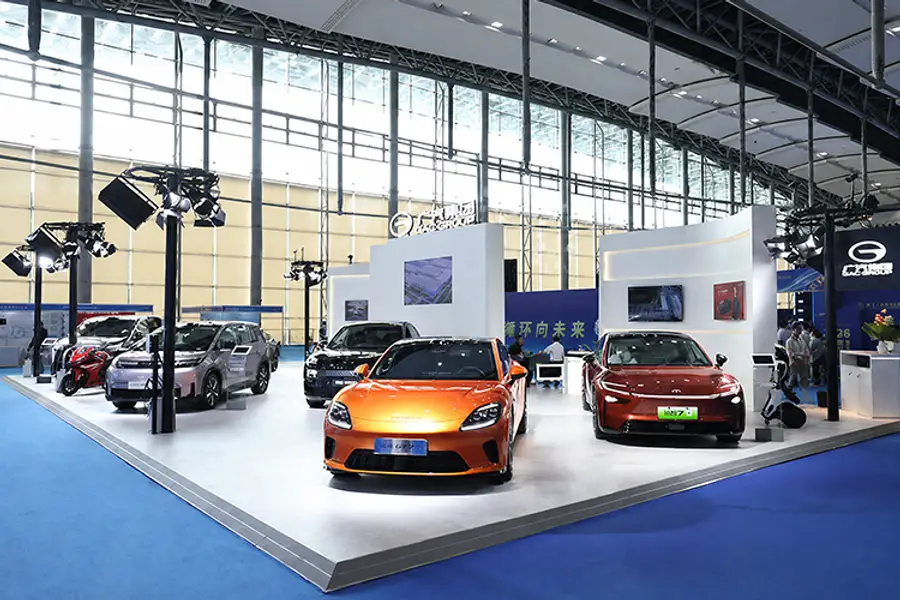
GAC plans to issue new shares in exchange for an equity stake in a vehicle joint venture held by FAW, though detailed transaction specifics have yet to be disclosed
Key Takeaways:
- GAC will use shares from its Shanghai-listed entity to pay for a partial equity stake it plans to acquire in a joint venture of rival FAW
- China’s auto regulator has issued a notice encouraging mergers and restructuring for companies from the nation’s oversupplied car sector
By Bai Xin Rui
A decade of rapid buildup, first in traditional internal combustion cars and more recently in new energy vehicles, has left China’s auto industry with an oversupply hangover, complete with price wars and shifting global supply chains. Now, the industry is in sore need of consolidation, which has yet to really materialize.
But that could be changing, following an announcement last week by Guangzhou Automobile Group Co. Ltd. (2238.HK; 601238.SH), one of China’s largest state-owned giants, of a new letter of intent with rival FAW Group. GAC said it plans to acquire an equity stake in a whole-vehicle joint venture held by FAW, which will receive newly issued shares from GAC’s Shanghai-listed entity as payment. The move will make FAW GAC’s second-largest shareholder.
Buoyed by the news that hinted at consolidation of two major players, GAC’s stock initially surged as much as 16% the day after announcement, before giving back much of that to close up a more modest 2.6% for the day.
Strong brand lineups
Just three days before the announcement, China’s Ministry of Industry and Information Technology (MIIT), which oversees the auto sector, held a press conference where it indicated its support for consolidation and restructuring of China large automakers, including through integration of their R&D departments and production resources to ease overheated competition. That led some to predict consolidation among state-run players, since such companies often take their cues from policies originating in Beijing.
GAC was established in 1997 and is the largest automaker in Guangzhou, capital of South China’s affluent Guangdong province. It is overseen by the Guangzhou branch of the State-owned Assets Supervision and Administration Commission (SASAC), the national organization that oversees all of China’s largest state-owned assets. Its portfolio of brands includes Trumpchi and Aion, and it also has joint ventures with Japanese giants Toyota (7203.T) and Honda (7267.T).
FAW is one of China’s oldest car makers, previously known as First Auto Works, and is the largest automaker in northern China, with headquarters in Changchun, capital of Northeastern Jilin province. Along with Dongfeng Motor and Changan Auto, it is a first-tier state-owned enterprise directly overseen by SASAC, rather than a local branch like GAC is. FAW’s brands include Hongqi and Jiefang, and the company also has joint ventures with Toyota and Volkswagen (VOW.DE).
Some initially thought the announcement might presage a merger between GAC’s and FAW’s separate Toyota joint ventures. But while the transaction does involve FAW Toyota, GAC will not fully acquire all of FAW’s equity in FAW Toyota, according to a report in financial magazine Caijing.
Specifics of the tie-up have yet to be disclosed. But it’s no secret that overheated competition in China’s auto sector has wreaked havoc on most companies’ finances, including GAC’s. The company lost a massive 4.47 billion yuan ($667 million) in the first half of the year, wider by 76% from its loss a year earlier. Its gross margin stood at a negative 4.25%, meaning it lost money on every vehicle it sold.
The company blamed the dismal performance on intense competition at home, locally referred to as “involution,” along with rising raw material costs. Its joint venture brands also came under pressure, even as sales volumes declined, further adding to the company’s woes.
10-year low profit margins
The central government hasn’t sat by idly during the bloodbath, rolling out a steady stream of new policies over the last two years aimed at stabilizing the industry. But those measures have had little effect. According to data from the China Passenger Car Association (CPCA), the automotive industry’s profit margin dropped from 6.1% in 2021 to just 4.1% in 2025. And the situation shows no signs of easing. The average profit margin for full-vehicle manufacturing in China sank further to a scant 1.5% in the first half of 2026, marking a new 10-year low, according to Chen Shihua, deputy secretary general of the China Association of Automobile Manufacturers (CAAM).
M&A is seen as one of the few remaining ways to ease the involution, and reaction by investment banks to the GAC-FAW tie-up has been generally positive. Citi believes that FAW will wield strategic influence at GAC after becoming its second-largest shareholder, and viewed the move as China’s first concrete action in promoting consolidation of state-owned automakers, aligning with the country’s latest Five Year Plan launched this year.
Meanwhile, Daiwa estimates the tie-up will produce a cross-shareholding structure that will promote broader strategic cooperation between the two automakers. But Daiwa also noted that the automotive industry is currently weak, and said it expects that more significant financial improvements may take several years to materialize. It also pointed out the deal could signal more similar tie-ups down the road, which would benefit the entire automotive industry.
Faced with the harsh industry winter and profit margins at a decade low, the cross-regional equity restructuring between GAC and FAW may sound to many like the first step in a wave of mergers and restructuring among Chinese automakers over the next five years. In addition to breaking down barriers between central and local state-owned enterprises, the deal sends a strong signal of Beijing’s determination to eliminate cutthroat competition and curb excess production capacity once and for all.
Investors generally see the cross-shareholding arrangement between GAC and FAW as a positive signal for integrating industry resources and bringing back market discipline. But as price wars roll on, undercutting margins, merely relying on incremental reinforcements at the equity level may not be enough to provide near-term relief for most companies. In the longer run, GAC and FAW will need to show that they can generate substantial synergies in areas like technological R&D and supply chain efficiency, which will determine the success of any new restructuring wave.
To subscribe to Bamboo Works weekly free newsletter, click here
Related Articles
RELATED ARTICLES
-
New SORL’s IPO plows into winter for China auto stocks
-
Chery tiptoes into Japan with EV ‘kei’ microcar joint venture
9973.HK
-
Energized by strong profit growth, Zenergy Battery eyes Shenzhen IPO
3677.HK
-
Qfin gets frostbite as fintech winter intensifies
QFIN.US
- Qingtao Energy reaches solid-state battery milestone, but model remains unproven
- Guotai Haitong proves that in China’s brokerage consolidation, bigger really is better
-
SICC returns to growth and profits. But China’s SiC industry faces a tougher test
2631.HK688234.SHG