China’s baby bust drives Kidswant pivot to scalp care
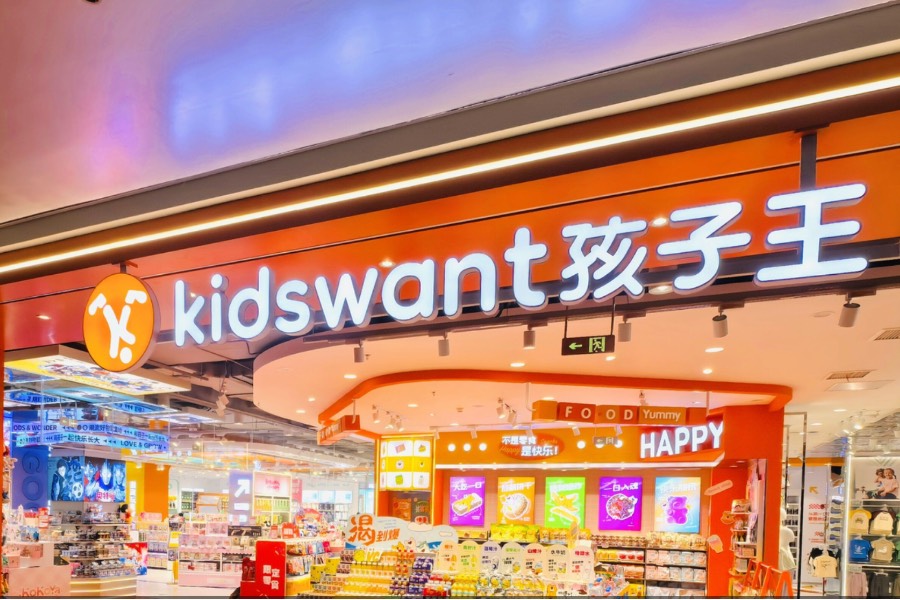
The company has filed for a Hong Kong IPO, cultivating a second growth curve in high-margin areas like scalp care, as its core maternal and infant products business stagnates
Key Takeaways:
- Kidswant has filed to list in Hong Kong, reporting its revenue rose above 10 billion yuan last year, even as growth for its core maternal and infant business slows
- The company is looking for new growth engines in high-margin businesses such as scalp care and marketing services
By Lee Shih Ta
China’s fertility rate continues to sink as a growing number of people opt out of parenthood. And yet the market for maternal and infant products will always be lucrative for companies that provide items desired by remaining parents, who are often willing to spend lavishly on their children. That predicament presents a core contradiction tugging at Kidswant Children Products Co. Ltd. (301078.SZ).
Last week, the maternal and infant retailing leader renewed its application for a Hong Kong IPO, which would complement its existing listing in Shenzhen. This time around, Kidswant is aiming to lure investors with new financials showing it broke through the 10 billion yuan ($1.47 billion) revenue mark last year. But investors may be unimpressed, worried about the stagnating Chinese market for the company’s core maternal and infant products.
The company’s business includes sales of products like milk powder, diapers and children’s clothing, alongside services related to areas like child development and parenting. Despite China’s falling fertility rate, the company has managed to keep its revenue growing. The figure reached 10.27 billion yuan last year, up about 10% from 2024. Its net profit last year jumped by an even bigger 64.2% to 298 million yuan. The revenue growth slowed to 2.46% in the first quarter of this year, hitting 2.46 billion yuan, though its profit continued expanding at a healthier clip, rising 56.79% year-on-year to 48.62 million yuan.
Kidswant ranked first in China’s maternal, infant and child products and services market last year, generating 13.7 billion yuan in gross merchandise value (GMV). But the market remains extremely fragmented, reflected by the company’s miniscule share of just 0.3%, in a market where the top five players combined controlled just 1%. That’s a good thing for leaders like Kidswant, showing they could grow through consolidation in a market where overall growth remains weak. The Chinese market for maternal, infant, and child products and services averaged 3.3% annual growth from 2020 to 2025, and is expected to grow 4% annually from 2026 to 2029, according to market data in Kidswant’s listing document. Consolidation may offer one way to outperform those low growth rates, as well as finding more consumption scenarios from within the market catering to new parents and their infant children.
As a result, Kidswant has positioned itself as a parent-child family services provider. By the end of 2025, the company had amassed over 98 million registered members and more than 12 million active members, while its offline sales and service network reached a total of 3,821 stores, effectively covering nearly all of China.
The company’s strategy is to extend one-off transactions into sustained family consumption over time. In 2025, total revenue from sources other than the sales of maternal and infant merchandise accounted for approximately 15.6% of the company’s total. While that remains relatively small, it nonetheless forms the nucleus of a transformation Kidswant is trying to make.
Family care scenarios
As part of that transformation, Kidswant acquired the Hairology Group a year ago, extending its business to broader adult family consumption. Hairology provides scalp and hair care products and related services. Following the purchase, Hairology contributed 379 million yuan in revenue last year, accounting for 3.7% of the total. While small in terms of revenue contribution, the segment was a bigger contributor to Kidswant’s bottom line, thanks to its gross margin of 67.2% – more than triple the 21.2% gross margin for the maternal, infant and child business.
The scalp care market also has more potential than maternal and infant products. Data cited in the listing application shows China’s scalp and hair care market was worth 67.5 billion yuan in 2025, and is expected to grow 11% annually to reach 102.7 billion yuan by 2029. In short, the Hairology acquisition enables Kidswant to pivot from the low-margin and slow-growth maternal and infant retail business into the higher-margin and faster-growing domain of family healthcare scenarios.
The reality is that the company’s core maternal and infant business has been facing pressure for a while now. Revenue from that segment rose 5.88% last year, lagging the company’s overall growth rate. Meanwhile, the segment’s gross margin declined from 23.1% in 2024 to 21.2% last year, with the gross margin for the sale of maternal, infant, and child merchandise similarly dropping from 21.1% to 19.4%.
But such transformations also come at a cost. From 2023 to 2025, Kidswant’s net cash flow generated from operating activities grew from 804 million yuan to 1.44 billion yuan, proving that its core business still possesses strong self-sustaining cash-generation capabilities. But over that time, cash outflow tied to investing activities grew substantially from 1.2 billion yuan to 1.84 billion yuan, causing the company’s cash to plunge by more than half from 2.29 billion yuan to 1.01 billion yuan. The company’s debt-to-asset ratio similarly climbed from 56.8% at the end of 2024 to 62.7% last year.
At the same time, the company’s acquisitions of Hairology and another company, Fortune Biotechnology, caused its goodwill to balloon from 782 million yuan at the end of 2024 to 1.93 billion yuan at the end of 2025, raising the prospect of future asset impairment charges.
Kidswant’s decision to pursue a Hong Kong listing looks aimed at supporting its ongoing transformation. The application indicates that funds raised will be used for product innovation, sales and service network expansion, strategic acquisitions and the enhancement of digitalization capabilities, among other things.
Valuation could be one of the company’s biggest challenges. Hong Kong-listed Goodbaby International (1086.HK) recorded revenue of HK$8.66 billion ($1.1 billion) last year, lower than Kidswant’s 10.27 billion yuan. Goodbaby’s current market capitalization sits at just HK$1.37 billion, giving it a relatively low price-to-earnings (P/E) ratio of about 6 times. That could pose problems for Kidswant if it hopes its Hong Kong listing can match the market capitalization of more than 8 billion yuan and P/E ratio of 28 for its Shenzhen-listed shares.
This big gap implies that even if Kidswant manages to list in Hong Kong, it’s unlikely to achieve a valuation on par with its Shenzhen-traded shares by solely relying on its core maternal and infant business. Ultimately, its ability to attain higher multiples than rivals like Goodbaby may depend on whether its new businesses, like scalp care, can meaningfully lift its overall gross margins and add some new life to its growth trajectory.
To subscribe to Bamboo Works weekly free newsletter, click here
Related Articles

RELATED ARTICLES
-
Fast-rising toothpaste newcomer brushes up for IPO

- Futu delivers more blockbuster results as pivot from China pays off
-
Andre Juice’s PCB gambit: A sweet pivot or a sour distraction?
2218.HK605198.SHG
-
CiDi drives beyond China with new British partnership
3881.HK
-
H World’s results highlight pivot to higher-quality, asset-light growth
HTHT.US1179.HK
- Lingxing drives into congested Hong Kong ride-hailing IPO lane