Annto drives out from Midea’s shadow with Hong Kong IPO
The behind-the-scenes provider of supply chain logistics services for manufacturers has an impressive revenue base, but it operates on paper-thin profit margins
Key Takeaways:
- Annto has filed for a Hong Kong IPO as parent Midea seeks to let its former logistics unit stand on its own
- The company operates on a gross margin of just 7%, as its heavy reliance on Midea for business leaves it with little pricing power
By Warren Yang
A massive revenue base can impress investors at first glance, making a company look like a corporate giant. But those big numbers mean little if only a tiny portion of that money trickles down to the company’s bottom line.
Annto Supply Chain Technology Co. Ltd. is a classic example of such a top-line mirage. As it seeks a Hong Kong listing, its biggest challenge will be spinning its paper-thin margins into an attractive investment case as a logistics middleman for manufacturers, led by its biggest client and parent Midea, one of the world’s top home appliance makers.
Annto’s prospectus, filed last week, features some big numbers that make the company look like a cash cow to the undiscerning eye. Its revenue grew at a solid annual growth rate of 15% over the last three years to reach an impressive 21.5 billion yuan ($2.96 billion) in 2025.
But peel back the wrapper, and the not-so-glamourous financial reality of Annto’s business model becomes starkly vivid. The company plays the grueling, low-margin role of a logistics-problem solver, mostly for Midea. In effect, most of its big numbers come from securing logistics facilities and services from third party suppliers, and then making them available to Midea and other clients for tiny markups.
Demand for supply chain logistics services is rising across China as domestic manufacturers look for ways to lower costs by outsourcing their warehousing and freight management needs to specialists like Annto.
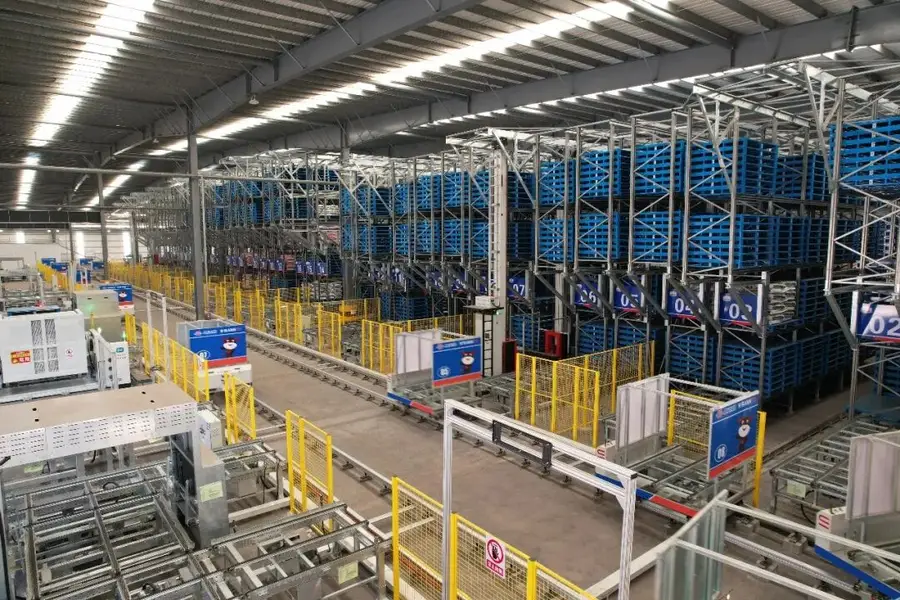
By employing sophisticated delivery models and automated sorting robotics, Annto can cut a factory’s inventory costs significantly. Unsurprisingly, home appliance supply chain management is Annto’s crown jewel due to its Midea ties. It offers an “integrated production logistics” model, managing everything from the raw steel and compressors going into air conditioners, to the final “last-mile” delivery of a heavy refrigerator to a consumer’s doorstep. Annto is the largest integrated supply chain solution provider for the domestic home appliance industry, according to third-party research cited in its prospectus.
However, while demand for these advanced, data-driven coordination services is growing, actual profits for the company and other operators are heavily capped by their large overhead.
Razor-thin margins
Annto operates on a razor-thin gross profit margin of about 7% as it relies on an army of third-party drivers, manual laborers and warehouse leases. Other expenses further squeeze its net profit margin to a miserable 2%. That means the company made a net profit of just 449 million yuan last year, despite the mountain of money it brought in as revenue from Midea and other customers.
For investors following companies with similar business models, Annto’s financial profile should sound familiar. For example, the gross profit margin for JD Logistics (2618.HK), a unit of e-commerce giant JD.com, is similarly thin.
Annto’s heavy reliance on Midea, which supplies more than two-thirds of its revenue, puts further pressure on its margins. Essentially, Annto’s primary job is doing behind-the-scenes work for its parent for tiny fees. When a single customer controls that much of a company’s business pipeline, its pricing power is tenuous at best, especially if that customer is also its controlling shareholder.
Midea’s biggest responsibility is to its own shareholders, who want to see the company boost its profitability. That means Midea can squeeze Annto on fees, giving the latter little choice but to absorb the blow. Worse yet, a shift in the Midea relationship, including an outright severing of ties or diversification to using other logistics vendors, could easily plunge Annto into a crisis. This could leave Annto’s independent minority shareholders, should its IPO succeed, constantly worrying about the company’s lopsided relationship that strongly favors Midea. Annto is up front about this risk.
“We have a high degree of customer concentration and rely significantly on our controlling shareholder,” Annto said in its prospectus. “If Midea Group terminates, reduces, or adversely alters the terms of its logistics and supply chain agreements with us, our business, financial condition, and results of operations would be materially and adversely affected.”
This isn’t a theoretical risk. For a real life example, look no further than what happened to JD Logistics soon after its IPO. Its e-commerce parent, JD.com, adjusted its internal fulfillment pricing to weather market headwinds, and the logistics arm bore the brunt of that decision, posting massive net losses in 2021 and 2022. It only returned to profitability by pivoting to other third-party customers – something Annto will also be trying to do. But its shares are still down more than 70% from their peak in 2021.
JD Logistics shares trade at a trailing price-to-earnings (P/E) ratio of just 10.9 and an even weaker price-to-sales (P/S) multiple of just 0.3. At the same P/S ratio, Annto’s market capitalization would be about 6.5 billion yuan, or less than $1 billion. Using JD Logistics’ P/E ratio as a benchmark would drop Annto’s value to an even smaller 4.9 billion yuan, reiterating the company’s weak bottom line that could easily drop into the red if Midea’s demands become too burdensome.
Furthermore, the Chinese home appliance market is mature and deeply cyclical, tethered directly to a sluggish domestic real estate sector where new home sales have plunged for several years now.
These risks are forcing Annto to expand its customer base beyond home appliances to include makers of fast-moving consumer goods, auto parts and electronics. But entering those areas also means going toe-to-toe with fiercely competitive logistics heavyweights like JD Logistics and S.F. Holding (6936.HK; 002352.SZ). In any pure price war with these deep-pocketed and highly experienced rivals, Annto’s already-poor margins would suffer even more.
Fresh capital from the Hong Kong IPO may help Annto become more competitive. It plans to use the proceeds to upgrade its digital supply chain platform, automate its warehousing network, and fund an aggressive expansion into third-party customer markets.
In trying to lure investors, Annto will probably pitch a narrative of digital supply chains, automated fulfillment centers and its ties to a global appliance giant. But unless it can wean its massive revenue machine from huge dependence on its parent, investors might want to let this new share delivery pass them by.
To subscribe to Bamboo Works weekly free newsletter, click here
Related Articles