Fengyi IPO tests AI’s ability to fix China’s unmanned retail problem
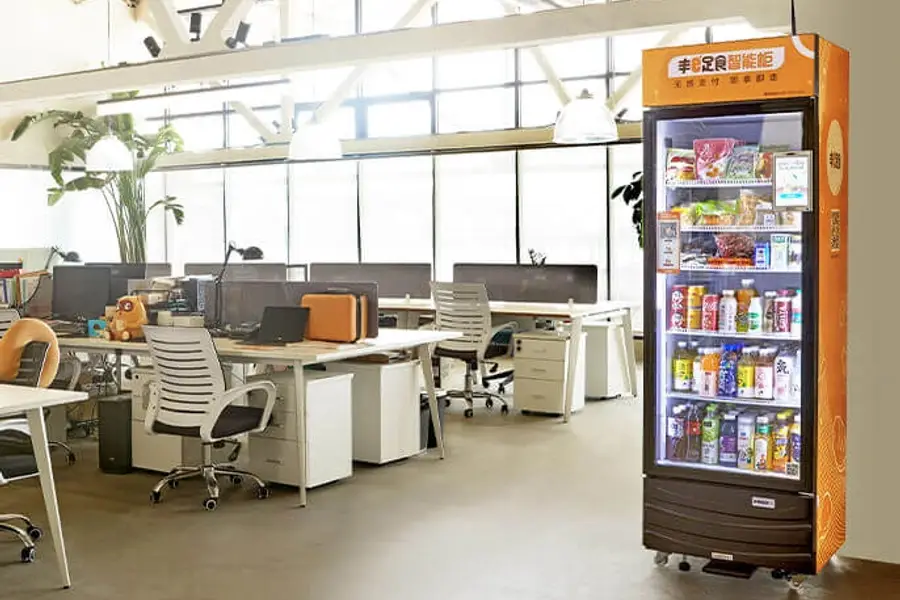
The company is part of a second generation of unmanned retailers, as its Hong Kong IPO tests investor appetite for a cabinet network offering help-yourself snacks and drinks
Key Takeaways
- Fengyi Technology has filed for a Hong Kong IPO, after building China’s largest smart retail cabinet network with nearly 184,000 cabinets and 2 billion yuan in annual revenue
- The company’s business metrics are all moving in the right direction, but its thin margins show the difficulties of wringing profits from thousands of low-sales cabinets
By Hu Minghe
In office buildings, factory rest areas and campus corridors across major Chinese cities, a familiar ritual is playing out. A worker or student scans a QR code on a glass-fronted cabinet, which unlocks the door. She then opens the door, takes a bottle of tea, packet of biscuits or other drink or snack of choice, closes the door and walks away. The machine uses sensors to detect what was taken, and payment happens automatically.
Now, one of the biggest operators behind those cabinets, Shenzhen Fengyi Technology Group Co. Ltd., wants public investors to take the same “help yourself” approach with its stock. The smart cabinet operator filed for a Hong Kong IPO last week, unveiling a business that is thriving in a sector written off by many. Its menu includes some healthy growth, led by top-line revenue that rose to 2.01 billion yuan ($300 million) last year from 1.24 billion yuan in 2023. But the filing also shows why unmanned retail remains hard: Fengyi sells mostly cheap drinks and snacks, while managing a vast network of small retail points in lightly trafficked areas.
That makes the company less a hardware maker and more like a retailer whose stores happen to be tiny, unmanned and algorithm-managed. Nearly all of its revenue comes from selling goods through its cabinets, with advertising and other services still just small contributors. The company’s pitch is that AI can turn a logistics-heavy retail model into a scalable network able to operate both reliably and profitably.
Rocky history
History hasn’t been kind to this sector. China’s original unmanned retail boom began around 2017, the same year Fengyi was founded, when venture money flooded into open shelves placed in offices and gyms. The idea was simple: put snacks close to consumers in a friendly help-yourself format, and avoid store rent and cashiers. But the reality was harsher. Theft, stale inventory, poor replenishment and weak site discipline quickly wrecked the economics. Many early players collapsed almost as fast as they expanded.
Fengyi belongs to a second generation looking for success in the concept. Its cabinets are closed, reducing the theft problem that doomed open shelves. They also target what the company calls light-traffic scenarios: offices, factories, logistics parks, schools, hospitals and other semi-closed locations that traditional stores and vending machines may not cover efficiently. These places have fewer buyers than more open transport hubs or shopping malls. But they often have repeat users and lower site costs.
The tradeoff shows up in Fengyi’s market share. The company had about 184,000 installed smart retail cabinets at the end of 2025, giving it 21.5% of China’s installed base. But its share of industry gross merchandise value (GMV) was only 11.5%. Fengyi has more cabinets than anyone else, but its average cabinet sells less than higher-traffic rivals. It is betting that enough lighter traffic cabinets, managed efficiently, can add up to a profitable network.
The company is still losing money, though its earnings trend is more nuanced than the headline loss suggests. Its revenue rose 32.9% in 2024 and 21.6% in 2025. Gross margin improved from 52.4% in 2023 to 55.8% in 2025. And most importantly, it swung from a 14.2 million yuan operating loss in 2023 to operating profits of 48 million yuan in 2024 and 50.8 million yuan in 2025.
That is real progress, but not fat profitability. Fengyi’s 2025 operating margin was only 2.5%. Its selling and marketing expenses that year were 960.8 million yuan, accounting for nearly half of revenue and close to the company’s 1.12 billion yuan in gross profit. Those expenses reflect the reality of the business: site acquisition, local staff, cabinet operations, replenishment and customer service don’t disappear just because checkout is automated.
Fengyi is still losing money on a net basis due to non-cash financing items. But it’s profitable on an adjusted basis, including an adjusted net profit of 118.6 million yuan in 2025, up from 77.4 million yuan in 2024.
AI as efficiency tool
AI is central to Fengyi’s story, but should be understood as an efficiency tool rather than a magic sales engine. Fengyi’s Flow Pilot system helps decide where to place cabinets, what products to stock, when to refill them and how to route work across its network. In the fourth quarter of 2025, the system made nearly 120 million decisions a day, with about 20,000 requiring human intervention. As the system became more efficient, the average number of points handled by each operations manager rose from 303 in 2023 to 504 in 2025.
That matters in a business where it’s time-consuming and costly to manage thousands of small locations by hand. AI can reduce products running out of stock, improve selection and make refill routes more efficient for restockers. But it can’t make a quiet office corridor behave like a busy convenience store. The cabinet still needs enough real consumers reaching for enough drinks and snacks every day to create a profitable business.
Fengyi was originally founded as a subsidiary of delivery giant S.F. Holding, which helps to explain its strength in logistics. The company was incubated from a logistics culture, and that background may help it understand delivery routes, corporate customers and site operations. That relationship ended in 2024, when S.F. disposed of its remaining stake in the company, according to the listing document. Fengyi now describes itself as operating its own network of regional warehouses, front warehouses and delivery drivers.
Fengyi’s broader context operating in a Chinese environment also matters. The smart cabinet model fits China’s dense workplaces and schools, ubiquity of mobile payments and strong delivery networks.
Fengyi is not the first automated-retail name to test Hong Kong investors. Shares of smart vending machine operator Ubox (2429.HK) have lost nearly 80% of their value since it listed in 2023, as the company remained loss-making last year. Another rival, Qunabox (0917.HK), has lost about 60% of its value since its 2024 listing, even after swinging to a 290.1 million yuan profit in 2025. Those weak share performances show the bar may be high for yet another automated-retail listing.
Fengyi has already proved more than most unmanned retail startups did. It gained valuable lessons from the sector’s first shakeout, scaled its network, improved margins and has reached profitability on both an operating and adjusted net basis. The IPO now asks investors to believe AI and skillful logistics can turn a dispersed snack network into a durable and profitable retail platform. Fengyi may have solved many of the early issues with unmanned retail 1.0. But it still needs to prove that fix is valuable enough to entice public investors.
To subscribe to Bamboo Works weekly free newsletter, click here
Related Articles

RELATED ARTICLES
-
Yusheng IPO tests bumpy road for China’s used car market

- Fairland’s ‘smart pools’ swim closer to IPO with CSRC application
- Zhongding Intelligent eyes IPO as onsite logistics heat up
- Fairland IPO fails to impress with dive into the red, sinking margins
- NEWS WRAP: Lalatech fulfills 1 billion orders in 2025 as global expansion scales