The master franchisee for Domino’s Pizza in China aims to open 350 new stores this year, boosting its footprint by about a quarter
Key Takeaways:
- DPC Dash’s revenue rose 25% last year, as its profit more than doubled on a rapid expansion that included the net addition of 307 new stores during the year
- The master franchisee for Domino’s Pizza in China reported a slight same-store sales decrease for the year, though its tier one cities remained positive for that metric
By Doug Young
Why settle for 98% of the pie when you can have the whole thing?
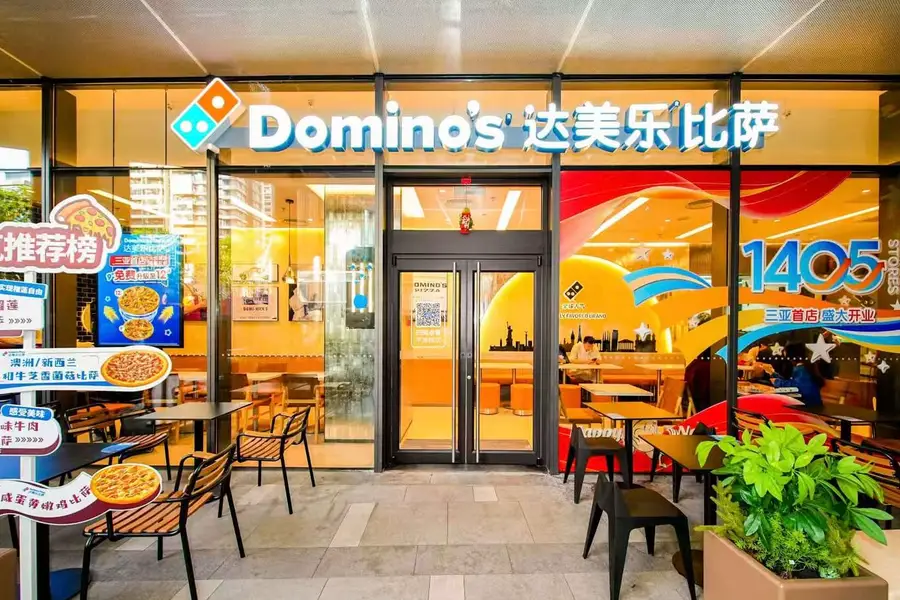
That’s what DPC Dash Ltd. (1405.HK), operator of the Domino’s Pizza (DPZ.US) chain in China, may have been thinking when it recently completed a clean sweep of the leader board for the 50 best-performing new Domino’s stores worldwide during their first 30 days. DPC revealed it achieved the milestone in its latest results announcement published on March 25, upping its previous claim to 49 of the 50 top spots midway through last year.
The company has powered its way to the top echelons of China’s pizza market through an aggressive expansion campaign, much of it focused on smaller Chinese cities, with names less familiar to most Westerners like Handan, in Central China’s Hebei province, and Hohhot in the Inner Mongolia region.
Those smaller markets have become some of DPC’s biggest cash cows, captivating local populations that sometimes line up for hours to sample a type of Western food often considered unusual and even exotic. As a result, many of the 50 top performers from DPC’s portfolio are in smaller markets. One of those, its first store in the Northeastern city of Dalian, generated a company record of close to 700,000 yuan, or about $100,000, on its first day of business in last year’s fourth quarter.
“It is a true demonstration of the strong momentum and recognition of the Domino’s Pizza brand and high demand of our products and services from the customers in China, forming a solid foundation of our continued rolling-out of our store footprint,” the company said in its announcement.
Despite taking over the Domino’s global leader board, the news was hardly all rosy for DPC as the company and its peers continued to operate in a stubbornly sluggish Chinese economy that is seeing consumers become increasingly cautious. Restaurant spending in China last year rose just 3.2% to 5.8 trillion yuan ($844 billion), according to China’s National Bureau of Statistics. And somewhat counterintuitively, the growth rate for “catering enterprises” grew at a slower 2.0% to 1.6 trillion yuan, showing large-scale operators like DPC are faring worse than average standalone stores in the current climate.
That sluggishness has led to less spending per consumer, pressuring margins and same-store sales. DPC has also discovered that owning Domino’s global leader board is not only a blessing but can also be a slight curse, since such super-performing stores inevitably record negative same-store sales growth in their second years as business normalizes. That factor ultimately dropped DPC’s overall same-store sales for the year into slightly negative territory, even as its older, more established stores continued to post gains.
Despite those challenges, the company revealed it will accelerate its store openings this year with a continued focus on smaller markets, which the company calls “non-Tier 1” in its reports. Those contrast with China’s largest megacities of Beijing, Shanghai, Shenzhen and Guangzhou, which are called Tier 1, and accounted for 39% of DPC’s total of 1,315 stores in 60 cities at the end of last year, down from 50% of the company’s 1,008 total stores in 39 cities a year earlier.
Accelerated store openings
Despite the economic headwinds, DPC revealed it plans to open 350 net new stores this year, marking a continued acceleration from the 307 it opened in 2025 and 240 in 2024. The company is already more than a quarter of the way to its latest goal, after opening 90 new stores in the first 26 days of January this year. It followed a similar pattern last year, opening 190 stores in the first half of the year before slowing the pace to 117 in the second half.
The company’s aggressive expansion has come mostly in the last four or five years, after it spent its earlier period refining a China business model that focuses on delivery and takeout dining, along with limited sit-down space. That formula also includes a high degree of localization, featuring made-for-China products like durian pizza, and pizza shaped like traditional Chinese coins for the Chinese New Year.
The company began collaborating with Domino’s as early as 2010, and became its master franchisee for China, Hong Kong and Macao seven years later. It spent its early years focused on the megacities of Beijing and Shanghai, before starting to move aggressively into other markets several years ago – a playbook followed by many big Western restaurant brands.
DPC’s revenue rose 24.8% last year to 5.38 billion yuan from 4.31 billion yuan a year earlier, which the company attributed to its expansion and strong performance from new stores. Reflecting its emphasis on smaller cities, revenue from non-tier one markets, which accounted for the big majority of new store openings last year, jumped 43.4% to 3.17 billion yuan. By comparison, Tier-1 markets recorded steady growth of 5.2% to 2.21 billion yuan.
DPC’s membership program that is central to developing customer loyalty rose 45% to 35.6 million users by the end of last year from 24.5 million a year earlier.
As we’ve previously noted, the normalizing of sales from recently opened stores in smaller markets dragged down DPC’s overall same-store sales by 1.5% for the year, though the company pointed out that stores in Tier-1 cities and ones opened before December 2022 remained positive throughout the year.
DPC’s store-level operating margin fell to 13.7% from 14.5%, which it attributed to ongoing resource investments such as labor costs amid its accelerated expansion, as well as “certain short-term pressures at the store level.” But its bottom line looked far stronger, with its net profit up 157% to 142 million yuan for the year, while its adjusted net profit rose 43.3% to 188 million yuan.
“We believe this is a solid result in very competitive markets with a generally soft consumer consumption environment,” the company said.
According to Bloomberg and public information, investors seem to generally agree, including big names like BlackRock, Capital Group Cos. and Vanguard, whose funds all own shares in DPC. While major shareholders have maintained stable holdings, DPC’s institutional shareholder base is relatively diversified. Still, the company’s shares have come under pressure lately amid broader concerns about weak consumer sentiment in China and limited stock liquidity. The stock fell after the announcement and is down about 28% this year, presenting a potential buying opportunity for investors looking to buy on the dip.
The Bamboo Works offers a wide-ranging mix of coverage on U.S.- and Hong Kong-listed Chinese companies, including some sponsored content. For additional queries, including questions on individual articles, please contact us by clicking here.
To subscribe to Bamboo Works free weekly newsletter, click here
Related Articles
Can Longcheer buy its way to the top of the AI rack?
Two auto giants hitch wagons to combat harsh industry winter