
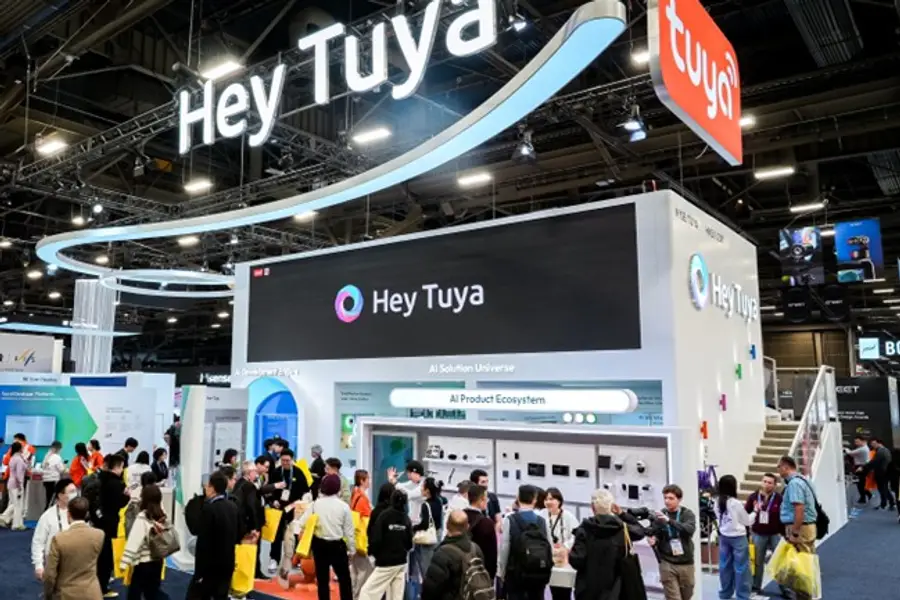
The AIoT company is drawing on its relationships with thousands of internet-connected smart device makers to roll out its Hey Tuya AI Assistant For Life
By Rene Vanguestaine
LAS VEGAS – Move over, Jarvis. A new assistant named Hey Tuya is coming soon to living rooms across the globe.
After spending almost all of its 12-year life serving business customers, mostly brands, OEMs, AI agents, system integrators and independent software vendors, Tuya Inc. (TUYA.US) unveiled its first consumer offering at the massive Consumer Electronics Show (CES) last week in Las Vegas.
The halls at this year’s CES, often considered a coming-out party for the latest high-tech gadgets and services, were humming with AI this year, as companies strutted their intelligent products and services harnessing the power of the internet combined with supercharged computing.
Tuya is a stalwart in both areas. It started out as an internet of things (IoT) provider helping companies connect their products and services to the internet, before upgrading to an AI cloud platform service provider that helps companies make their web-connected devices even smarter, relying on Tuya’s artificial intelligence of things (AIoT) capabilities.
Tuya was showing off its consumer-facing Hey Tuya at this year’s CES, with the name prominently displayed above its floorspace as it attended the show for an eighth year.
The product is currently still in the testing phases, with a rollout likely later this year. Alex Yang, co-founder, COO and CFO of Tuya Smart, discussed the new product with Bamboo Works in an interview at the show. The following questions and answers have been edited for brevity and clarity.
Q: Could you please briefly introduce the functional features of Hey Tuya? Is this the company’s first consumer-facing product?
A: Yes. It’s the first consumer-facing product that we’ve provided. But it’s consumer and developer-facing together. Hey Tuya is an AI Assistant For Life helping people to take care of their lives. It’s a physical life, right? Living in the real world. So, the assistant will be able to cover most of the scenarios you’re going to meet at home, including your calendar, your to-dos, your health, and how you interact with most of your own home devices. We try to make people’s lives easier with a virtual assistant working alongside them to interact with both internet and physical services.
Q: Who is your competition?
A: (Laughs) There is no one providing the same type of services as us. That’s the special value proposition Tuya is making. We offer a platform open for developers. We are the enablers helping people to make their innovations easier. You can consider that Hey Tuya will offer use cases for ideal applications on how you build an assistant. But at the same time, all the capabilities are open for our 1.6 million developers worldwide building all kinds of different things.

Q: How do you convince OEMs to actually work with you and embed your technology?
A: That’s why we decided to build this AI assistant. We believe the consumer needs it, but it’s more convincing because we have the legacy through the past 10 years of helping over 7,000 brands to build nearly 900 million devices. So, the first version of the Hey Tuya AI Assistant For Life will be compatible with around 60% of all those existing smart home devices.
Q: What are the challenges and future potential for Hey Tuya?
A: Considering the penetration of the smart home, the penetration for home devices is still low. Like six or seven percent of home devices are connected. So, it’s still at a very early stage. So, the first challenge is how we can speed up the cross-terminal or cross-device experience and speed up penetration of the entire global market.
The second is that AI is the key, and one of the key changes for AI is not how you can build things upon it, but also how you use it to build the application as well. So, the second challenge is how fast we can continuously identify the right scenarios that people need and the right capabilities and the right path to get there.
Q: What is the business model for Tuya?
A: Now we have three business models. The first one we call PaaS, platform as a service, to help the device makers. So, it will be an essential part of the device that comes with all the offerings that you can use to convert legacy devices into smart devices. That business model is very old school.
The second one is solutions. For these kinds of very emerging innovative items, we offer turnkey solutions, including the hardware design and all the software combined. Like with toys, for example. Some toy companies know nothing about electronics or software engineering. So, in the beginning we offer them a turnkey solution.
And the third one is software as a service (SaaS). So, it’s a recurring subscription model directly to end users. In software it’s what we call premium feature or add-on services on top of the devices to the end user. So, while you have the essential feature sets on devices, you can activate smarter features on the subscription model.
Q: How do you balance your business structure between developers and consumers?
A: From the business model perspective, right now it’s still like the B2B2C. So, we directly offer all our selling items at the B2B level. We are helping the device providers to build their devices, to provide their own applications easier and faster and more efficiently. But we continuously have the insight for the consumers and continue to build the right use cases, or best use cases, for the consumer. Then that can help my device builders to figure things out.
Q: What’s ahead for Tuya in 2026?
A: People were asking me whether AI devices are already starting to take place, whether demand was fake or already proven. I’ll say that 2025 will be like the essential year, or initial year for the AI device. Because we really are seeing that through our offering, we’re already starting to convince more and more developers to start trying out AI.
But they need education, they need to have more understanding and they need to bridge in what they can get from the technology side and combine it with what kind of innovative ideas and insight they have on the end-user to do that. So, as you can see, 2026 will be the booming or starting year for AI devices.
The Bamboo Works offers a wide-ranging mix of coverage on U.S.- and Hong Kong-listed Chinese companies, including some sponsored content. For additional queries, including questions on individual articles, please contact us by clicking here
To subscribe to Bamboo Works free weekly newsletter, click here
Related Articles

Senior Material’s quarterly profit surges, but investors unimpressed
Dongshan Precision targets AI optics with Hong Kong listing


