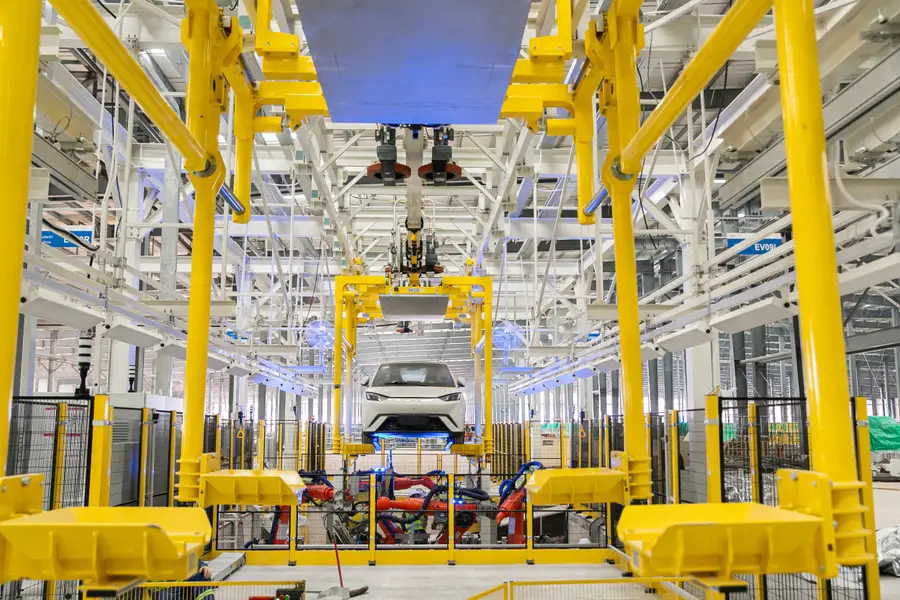
China’s EV giant overtook Tesla in unit sales last year, but margin pressure, overseas risks and a controversial financing model raise questions on whether it can still deliver shareholder value
Key Takeaways:
- BYD’s global sales surge has not translated into higher profitability, as the company faces pressures from an ongoing price war at home and falling profits per vehicle
- The unwinding of the leading EV maker’s supplier‑financing scheme and rising overseas challenges threaten to lift its debt ratio and dampen its expansion
By Xia Fei
Chinese electric carmaker BYD Co. Ltd. (1211.HK; 002594.SZ), whose name stands for “Build Your Dreams,” may have just achieved one such vision: overtaking Elon Musk’s Tesla (TSLA.US) as the world’s biggest seller of electric vehicles (EVs). But that vision may be coming at a cost, quite literally, as BYD’s dream puts its profitability on a dangerously downward trajectory that sometimes comes with such aggressive expansion.
The Shenzhen-based company basked in the global spotlight earlier this month when it revealed that it sold 2.26 million EVs globally in 2025, driven by 145% year-on-year growth abroad. By comparison, Tesla’s battery-powered car deliveries fell 8.6% to 1.6 million last year, the largest annual drop in its history.
That resounding trading of places looks like a sweeping victory for BYD. Within China, where domestic brands already reign, Tesla’s sales fell for the first time by more than 5% to around 620,000 vehicles — the first decline since its Shanghai gigafactory opened in 2020. BYD also outpaced Tesla in sales both in Britain and Germany, a sign that Chinese brands are starting to make headway into more affluent markets.
Such stark contrast marks a powerful riposte for Wang Chuanfu, a low-profile chemist who founded BYD as a battery maker in 1995, against Musk, who mocked the Chinese company as a rival more than a decade ago. Beyond car making, BYD has also invested heavily in energy storage and smart driving systems, moves that could help offset margin pressure amid a worsening price war that began in China and is rapidly being exported abroad by Chinese EV brands.
BYD’s triumph owes in no small part to its heavy presence at the lower end of the market. Its Seagull models start at around just $8,000, and already include the company’s own “God’s Eye” self-driving system. That’s miles ahead of Tesla, whose entry-level Model 3 starts at $35,000 and has only gained partial approval to operate assisted driving in China.
But investors should think twice before jumping on the BYD bandwagon. Despite its triumph in scaling up rapidly, a much tougher battle for BYD is just starting: how to translate its huge volumes into higher profits.
In last year’s third quarter, BYD reported its net profit slumped by 32.6% to 7.8 billion yuan ($1.1 billion), representing its steepest fall in over four years. Revenue also fell for the first time in over five years to 195 billion yuan, a sharp reversal from its strong double-digit growth in 2023 and 2024.
By some measures, BYD’s profitability is still competitive with Tesla. Its gross margin was 17.9% in last year’s third quarter, roughly equal to Tesla’s 18%. But a Morgan Stanley report showed BYD’s per-vehicle profit fell to just 4,800 yuan in last year’s second quarter, down from 8,000 yuan the previous quarter — a fraction of Tesla’s roughly $6,000 per vehicle in 2024.
Challenge of staying profitable
Cutthroat competition in China, where rivals race to sell cars on thin margins, and profits remain elusive for most companies, threatens to further compress BYD’s profitability. Higher vehicle purchase taxes, reduced government subsidies for lower-end EVs and ongoing competition will likely mean a more brutal year for BYD and other Chinese car brands ahead.
At the same time, China’s EV market is showing signs of slowing sharply after several years of rapid growth. Analysts at S&P Global predict China’s car sales – roughly half of which now come from new energy vehicles (NEVs) – will fall in China in 2026, leaving BYD and its peers little choice but to subsidize consumers further, squeezing margins again.
As pressures mount at home, BYD is racing to localize production on a mass scale in Southeast Asia, Latin America and Europe, partly to sidestep tariffs and quicken delivery cycles. But building plants overseas is now a far more complex undertaking, especially as governments in countries from Brazil to Mexico scrutinize BYD’s plans to build local factories, and China itself worries about transferring cutting-edge technologies to those markets.
Another overlooked uncertainty for the world’s new EV king comes from government pressure that has forced the company to quietly dismantle a supply chain financing scheme that long helped to power its relentless expansion.
Dubbed Dilian, BYD pioneered the shadow financing system by issuing electronic IOUs to its vast web of suppliers in lieu of more immediate payments. That system ballooned to more than 400 billion yuan ($57.3 billion) in such IOU debt as of May 2023, according to the latest data released by the company.
This instrument allowed BYD to stretch the payment cycle for its suppliers to 127 days on average, above the industry average of 108 days, according to a Reuters report in November. Data compiled by Bloomberg showed BYD took an average of 275 days to pay its suppliers in 2023. In many cases, suppliers used their Dilian notes as collateral to borrow more money from small banks or private lenders to keep funding their operations, creating a complex web of financing that has largely escaped official scrutiny.
Under regulatory pressure to abandon the tool and take pressure off its suppliers, BYD last summer pledged to shorten bill payment cycles to suppliers to 60 days.
Exiting Dilian is no simple task. BYD’s debt ratio stood at around 71% as of the third quarter of 2025, according to its latest disclosure. If the outstanding 223 billion yuan the company owed in trade payables at the end of last September is included, BYD’s actual debt ratio would soar to almost 96%, according to calculations using company data.
Despite the increasing headwinds it faces, the investment community still sees BYD as undervalued. Among 28 analysts polled by Marketscreener, 23 gave the company a “buy” or “outperform” rating, while only one recommended a “sell.” Analysts polled by Yahoo Finance expect the company to return to both revenue and profit growth this year.
Billionaire investor Charlie Munger, Warren Buffett’s longtime business partner, said in 2023 BYD was so far ahead of Tesla in China that it was “almost ridiculous,” and later praised founder Wang Chuanfu as better at “actually making things” than Elon Musk. Yet after a highly lucrative 17‑year run, Munger and Buffett’s Berkshire Hathaway, which made headlines when it acquired 10% of BYD in 2008, quietly disposed of its remaining stake last September. That lone vote of no confidence could speak far more loudly than all the other bullish analysts combined.
To subscribe to Bamboo Works weekly free newsletter, click here
Related Articles