Move over, Hong Kong. Young Beijing Exchange becomes China’s new IPO hub
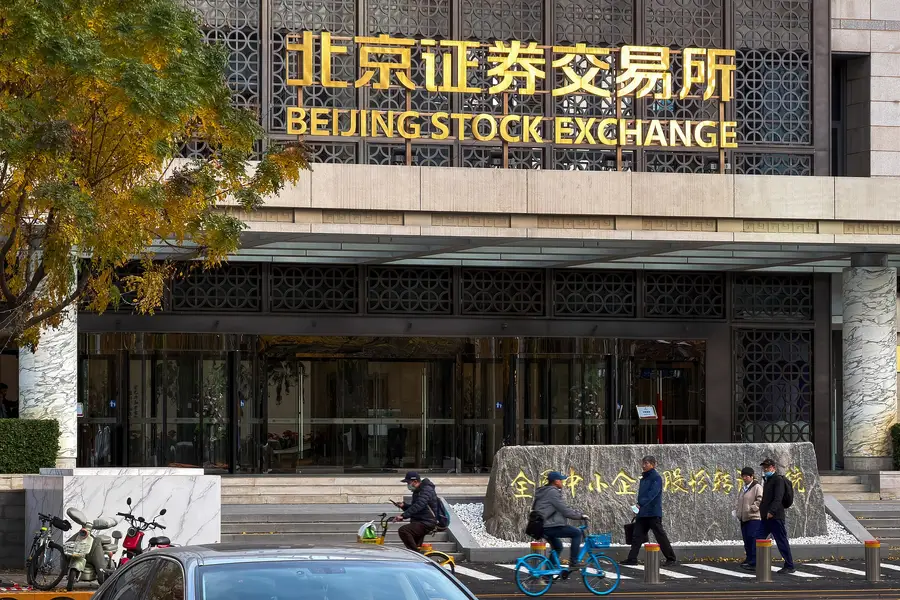
The bourse, launched in 2021 to help fund smaller tech startups, has hosted 38 IPOs this year, up more than 50% from 2024
Key Takeaways:
- Just four years after its launch, the Beijing Stock Exchange has quietly boomed this year by helping 38 startups raise about $1 billion
- The exchange is currently vetting another 172 IPO candidates, more than quadruple the number for both the rival STAR and ChiNext markets in Shanghai and Shenzhen
By Chen Ruzhen
Hong Kong maybe basking in the glow of an IPO frenzy that has made it the world’s hottest market for new listings this year. But to the north in China’s capital, a quieter, but also impressive, frenzy is shaping up on the Beijing Stock Exchange, once seen as a capital markets backwater. That quieter rush is drawing in throngs of listing hopefuls and investors seeking to tap into growing enthusiasm toward technology startups.
The bourse, kicked off by President Xi Jinping four years ago to help fund innovative small companies, has hosted 38 IPOs in 2025 – up over 50% from last year. That puts it on track to beat out the similarly startup-focused STAR Market in Shanghai and ChiNext in Shenzhen in terms of new listings.
The previously overlooked exchange is also currently vetting more IPO candidates than its two bigger rivals combined, thanks to surging investor interest in small-cap tech stocks. Analysts expect the momentum to extend into next year, as Beijing seeks to bolster the exchange’s role as a venue to fund China’s “little giants,” which are key to a national strategy toward supply chain independence, tech self-reliance and economic upgrading.
The Beijing Stock Exchange is helping companies “transform from being ‘small and beautiful’ to ‘strong and lasting,’” China Galaxy Securities said in its 2026 strategy report. “It also helps China develop a multi-tier capital market system” that can finance companies in various stages of their life cycles, it added.
IPO hub
In 2025, Chinese startups raised 7.2 billion yuan ($1 billion) via IPOs on the Beijing Stock Exchange. While that amount is still modest compared with the roughly $36.8 billion raised in Hong Kong IPOs this year, it’s still up 40% from a year ago. And we should also point out the IPOs in Beijing are far smaller than those in Hong Kong since they come from earlier stage and more specialized companies.
The 38 companies that sold shares in Beijing include precision equipment maker Zhuhai Nante Metal Technology (920124.BJE), medical diagnostics maker Dynamiker Biotechnology (920009.BJE) and energy equipment manufacturer Santacc Energy (920158.BJE). That compares with about a dozen IPOs on the STAR Market this year, and 30 on the ChiNext, although average fundraising size on the rival boards is also much bigger.
Underscoring the quiet revolution taking place in Beijing, the bourse in China’s capital is currently vetting 172 listing candidates – quadruple the 44 candidates currently being vetted on the STAR Market and 34 on the ChiNext, according to auditor KMPG. Bankers say smaller companies seeking fast listings are increasingly drawn to the Beijing exchange, which has the most relaxed requirements for IPO applications of any Chinese board.
Beijing is also home to another board, the National Equities Exchange and Quotations (NEEQ), once called the “New Third Board,” which has struggled to attract listings partly due to a high bar for investors that results in thin trading and low liquidity.
China’s securities regulators drastically tightened the screws on IPOs in Shanghai and Shenzhen in early 2024, especially on the STAR Market, which focuses on “hard technology” such as biotech and semiconductors as part of the country’s drive for self-sufficiency in those areas.
Facing prohibitively high bars for IPOs in Shanghai and Shenzhen, many companies are now seeking to list on the Beijing exchange, which has a lower threshold. Growing increasingly impatient, dozens of companies have withdrawn their applications from China’s two biggest exchanges, applying to float on the Beijing bourse instead.
For example, Shandong Haiaos Biotechnology announced this month it has hired bankers to help it prepare for an IPO on the Beijing exchange. Previously, the collagen casing producer had planned to list in Shenzhen. Other companies that have switched to Beijing include Beijing Wisdom Mechanical Technology, Zuxing New Materials, Beijing Beier Bioengineering and fintech firm Agree Technology.
Beijing has welcomed such companies by streamlining its vetting process, publishing listing criteria that include a wider range of applicants, and taking measures to improve market liquidity.
Trading boom
The exchange’s benchmark index, the Beijing Stock Exchange 50 Index, has jumped more than 40% so far this year, outperforming an 18% gain for the blue chip CSI300 index, and a 30% gain for Hong Kong’s Hang Seng Index. Average daily turnover has more than doubled from last year to roughly 30 billion yuan, as individual and institutional investors alike pile into the market. According to Huayuan Securities, the number of trading accounts reached almost 10 million, up from 7.6 million at the end of 2024.
The Beijing Stock Exchange has managed to perform better than the older NEEQ partly due to lower requirements for investors. Such investors must have accounts worth at least 500,000 yuan, the same as the STAR Market, and half the 1 million yuan required for NEEQ trading.
In a sign a virtuous cycle could be forming where IPOs and investors feed off each other, newly listed stocks on average popped up 354% on their Beijing exchange debuts, higher than 222% in Shanghai and 206% in Shenzhen, according to Huayuan Securities. Such big jumps are caused partly by stock exchange rules that often force companies to price their shares artificially low. But the better performance for Beijing compared with Shanghai and Shenzhen still attests to more excitement around companies listing on the newer Beijing exchange.
Analysts say the Beijing board has huge growth potential, as its size – despite this year’s rapid growth – still has yet to meet the government’s big expectations. Even after this year’s boom, the exchange’s total market cap is still less than 1 trillion yuan, a tiny fraction of 65 trillion yuan for Shanghai and 43 trillion yuan for Shenzhen.
Founder Securities expects the Beijing bourse to continue reforming its rules in 2026 to attract more IPO candidates and lure more investors. For example, mutual funds companies are expected to launch exchange-traded funds (ETFs) on the board that would channel fresh capital into the market, while pension funds and foreign institutions may also boost their activity as more tech startups get listed.
When the exchange was established in September 2021, President Xi said it should be a “hub for serving innovative small and medium-sized enterprises.” That mission is getting more imperative as the rivalry between China and the U.S. intensifies, and the world’s second-biggest economy loses growth momentum. And with China currently crafting a new Five Year Plan for its economic priorities from 2025 to 2029, the Beijing bourse could play an important role in helping to execute fundraising needed for that plan.
To subscribe to Bamboo Works weekly free newsletter, click here
Related Articles