Harrods retreats from Shanghai as private colleges face degree of reckoning
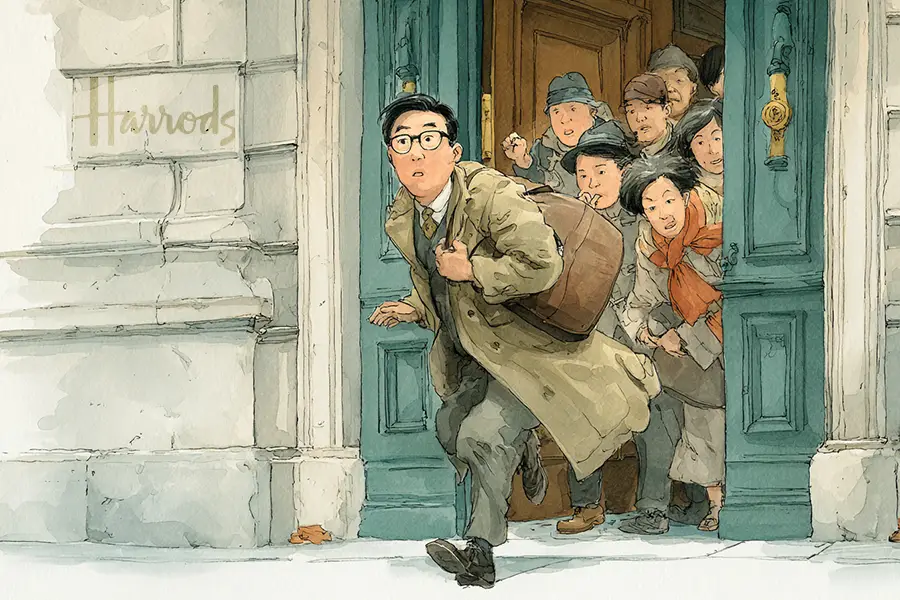
“The days of unlimited spending on Western luxury items by the Chinese public at large are gone, I think, forever.”

Key Takeaways:
- The departure of Harrods signals a permanent shift away from broad-based “conspicuous consumption,” though top-tier brands and tech giants like Apple retain their allure
- Private university operators like XJ International are struggling as the economic value of a degree fades, prompting a shift toward government-aligned vocational training
By Doug Young & Rene Vanguestaine
Disparate market signals often coalesce into a singular narrative of change. Two recent developments illuminate a distinct shift in China’s economic psyche: a move away from the pursuit of prestige for prestige’s sake, and toward a starker, more pragmatic reality.
We begin with the news that Harrods, the legendary British department store brand, is shuttering its Shanghai operations come January. This includes the Harrods Tea Rooms and its private club, Harrods the Residence. The closure ends a five-year experiment that began in 2020, not as a typical retail play, but as an attempt to sell a “British lifestyle.” The offering included curated social experiences and a steep 150,000 yuan ($21,000) membership fee.
In retrospect, we believe this was a case of profound bad timing and perhaps a misunderstanding of the market. The concept relied heavily on the allure of “conspicuous consumption” that defined an earlier, booming era of China’s economy. Charging astronomical fees for the privilege of drinking tea – even with Harrods teddy bears – makes sense only when cheap money is abundant. Furthermore, while French or Italian culture often sells itself as a luxury lifestyle in China, the appeal of a purely British social experience is arguably more niche.
There is also a demographic reality to this exit. The club model likely made sense when Shanghai was teeming with Western business executives mingling with wealthy Chinese entrepreneurs. However, geopolitical mayhem and the pandemic have driven many expatriates away, and they simply have not returned.
Does this signal a total collapse of Western luxury in China? We don’t think so. While “second-tier” luxury brands are scaling down, the top-tier players – like Hermes and Louis Vuitton – retain their ability to command high prices. Even Apple, despite headlines of dismaying sales, has seen a rebound; the iPhone 17 recently captured 25% market share. We observe this resilience on the ground, noting that airline crews and consumers in Beijing are still opting for the latest Apple hardware. The market is shrinking, but appetite for the absolute best remains. The days of unlimited spending by the public at large are gone, but the wealthy will continue to buy.
Diminishing returns of a university degree
While the wealthy rethink their club memberships, the middle class is rethinking its path to prosperity. This brings us to XJ International (1765.HK), a company running private universities, which is currently selling off underperforming campuses to service its heavy debt. Unlike the primary education sector, which was decimated by a regulatory crackdown in 2021, XJ is suffering from a shift in market demand.
There was a time when a college degree was viewed as the golden key to a successful future in China. That sentiment is reversing. We believe the economy, compounded by the looming specter of artificial intelligence, has fundamentally altered the value proposition of higher education. Today, a generic college degree is too often a direct route to unemployment.
Youth unemployment remains stubbornly high. Anecdotally, we hear constant reports from Beijing and Shanghai of graduates struggling to find well-paid work. When we look back on 2007, the going salary for a university graduate was around 3,000 yuan. Nearly two decades later, starting salaries haven’t risen significantly enough to justify the investment.
Consequently, we are seeing a pivot toward vocational education — a sector explicitly encouraged by President Xi. There is a growing realization that skilled trade jobs, such as electricians or plumbers, offer better protection against the AI revolution than lower-level white-collar corporate roles.
For investors looking at the education sector, the lesson is clear: align with government priorities or face existential risk. The ‘in-between’ private universities – those lacking the state-backed clout of elites like Peking University or Tsinghua University – are in a precarious position. Without the “Iron Rice Bowl” funding that protects those top-tier giants, these private institutions are vulnerable to demographic shifts and regulatory changes. The smart money, we believe, will steer clear of this squeezed middle and instead follow the state’s roadmap: investing in vocational training, high-tech, AI, and green energy education. Ultimately, both Harrods and XJ International are casualties of a maturing, tightening environment. Whether it is a 150,000 yuan social club or a four-year degree, Chinese consumers are no longer buying the brand; they are scrutinizing the value.
About China Inc
China Inc by Bamboo Works discusses the latest developments on Chinese companies listed in Hong Kong and the United States to drive informed decision-making for investors and others interested in this dynamic group of companies.
Subscribe to China Inc on your favorite app:


Related Articles
Can Longcheer buy its way to the top of the AI rack?
Two auto giants hitch wagons to combat harsh industry winter