Zeekr drives off Wall Street, heralding chilly year ahead for U.S. Chinese listings
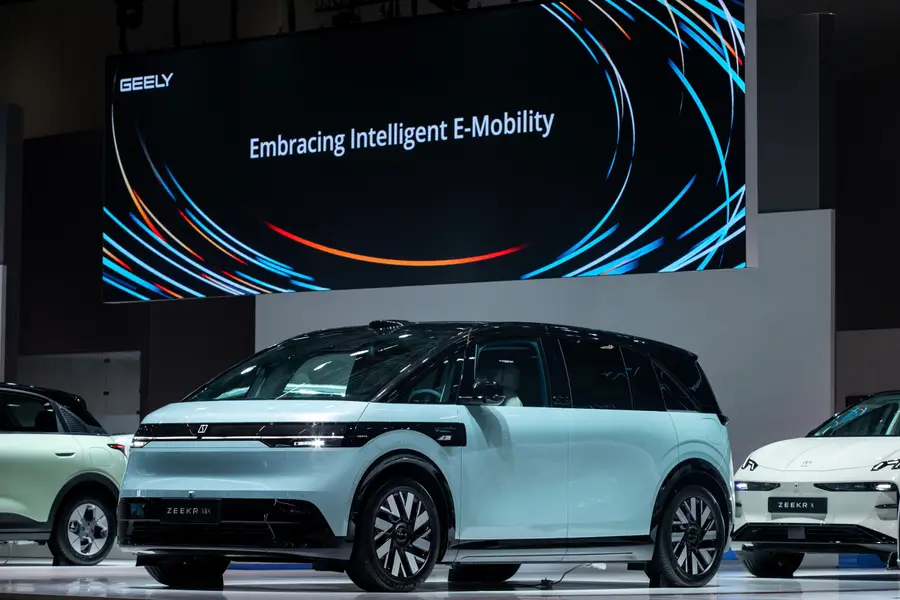
Trading of the EV maker’s shares was suspended on Dec. 22, after investors approved a plan by parent Geely to privatize the company less than two years after its IPO
Key Takeaways:
- Zeekr’s shares were suspended on the New York Stock Exchange on Monday, moving it closer to its planned delisting and merger with Hong Kong-traded parent Geely
- The EV maker’s move was driven by company-specific factors as well as an increasingly hostile environment for Chinese companies on Wall Street
By Doug Young
While 2025 has been a banner year for Hong Kong IPOs, the exact opposite has been true for the U.S., once a preferred listing destination for fast-growth private Chinese firms. So, it seems quite fitting that one of the biggest movements by a Chinese company on Wall Street this year comes with the departure of electric vehicle (EV) maker Zeekr Intelligent Technology Holding Ltd. (ZK.US) from the New York Stock Exchange as we head into the final week of 2025.
Zeekr first announced its plan to delist in May, roughly a year after it raised $440 million in one of the biggest new listings by a Chinese company on Wall Street in 2024. So, its departure, announced by the company on Monday in New York, could technically be seen as subtracting $440 million from this year’s total fundraising on Wall Street by Chinese firms.
The year was already looking quite miserable for such fundraising, which is expected to total about $1.12 billion by 63 Chinese firms for all 2025, according to Deloitte. That compares with $1.91 billion raised by 59 companies in 2024, showing the number of new listings grew but the average size shrank to just $18 million per IPO this year from $32 million in 2024. If we count Zeekr’s privatization as $440 million in negative fundraising, then Chinese firms only raised $680 million on Wall Street this year.
Zeekr’s brief life as a listed company was full of twists and turns, and its privatization wasn’t all smooth sailing. After selling American depositary shares (ADS) for $21 apiece, the stock traded as low as $13 and as high as $30, as investors wavered between positive and negative on the company’s prospects in China’s crowded new energy vehicle (NEV) market. Complicating matters, parent Geely (0175.HK) forced a marriage between its Lynk & Co. luxury car arm and Zeekr in late 2024, leaving many Zeekr shareholders unhappy.
Geely first offered to privatize the company for $25.66 per ADS in May this year, representing a decent but not spectacular 22% premium from Zeekr’s IPO price. But after protests from a group of early investors, including big names like battery leader CATL, online video giant Bilibili and Intel Capital, Geely ultimately raised its price slightly to $26.87. It also offered investors the option to exchange each ADS for 12.3 shares of Hong Kong-listed Geely, which translates to about $26.77, based on the stock’s Monday closing price.
Zeekr’s prospects and its financials were hardly exciting at the time of its privatization, which took a major step towards completion with the suspension of trading in its shares on Dec. 22. The company’s final financial report as a New York-listed company shows its revenue rose 9% year-on-year to 31.6 billion yuan ($4.5 billion) in the third quarter, while its loss for the period narrowed to 307 million yuan from 2.03 billion yuan a year earlier. Notably, the company’s gross margin improved to 19.2% in the latest period from 15.2% a year earlier as its EV operations gained scale and Lynk & Co. contributed to its business.
Falling EV sales
Zeekr’s latest single-digit revenue growth was hardly cause for excitement. And even that figure glossed over the fact that sales for its namesake EV business – which was supposed to be its main growth engine – are shrinking. According to monthly sales data released by the company, sales of its Zeekr brand EVs totaled 193,866 in the first 11 months of the year, down 0.55% year-on-year. Its Lynk & Co. sales rose 22% during that time to 316,744 units, with the result that the company’s overall vehicle sales rose 12.4% in the first 11 months of 2025.
Following the privatization, Zeekr will become a wholly owned unit of the listed Geely, which already owned 65.7% of Zeekr stock before the privatization announcement.
Zeekr’s story, and its departure from Wall Street so soon after its listing, was mostly driven by company dynamics. Its merger into Geely is part of founder Li Shufu’s ongoing efforts to consolidate his sprawling car-centered empire. That already includes a diverse list of publicly traded companies, such as the Volvo (VOLCAR-B.ST) and Lotus (LOT.US) brands, as well as technology companies like Ecarx (ECX.US) and iMotion (1274.HK) and ride-hailing company CaoCao (2643.HK).
At the same time, the U.S. has become increasingly hostile to Chinese companies listing their shares on Wall Street. In the latest development on that front, the Nasdaq announced plans in September to crack down on small Chinese listings, saying it would require all companies to raise at least $25 million in their IPOs and maintain public floats of $5 million or more. Those rules are still being reviewed by the U.S. securities regulator.
“If Nasdaq’s proposed listing thresholds are passed in around the second quarter of 2026, fewer Chinese companies are expected to be able to fulfill these new requirements,” said Zhang Wei, national U.S. offering leader of Deloitte China’s Capital Market Services Group. “This could prompt many smaller Chinese companies to rethink their financing strategies and timetables.”
Some 54 Chinese companies currently have applications for Nasdaq listings awaiting approval by the China Securities Regulatory Commission (CSRC), China’s securities regulator, which must approve all such listings, according to its website. All of those applicants have hired small underwriters, according to the list, indicating many of the planned IPOs would probably be quite small and below the Nasdaq’s proposed $25 million minimum fundraising threshold.
Zeekr obviously wouldn’t have been affected by the new Nasdaq limits, as it is quite large, with a market value of nearly $7 billion at the time its shares were suspended. But its late arrival to China’s EV market, which is already quite crowded and showing rapid signs of slowing, hardly boded well for Zeekr if it had retained its status as a separately listed company.
At the end of the day, Zeekr’s departure from Wall Street shouldn’t come as a huge surprise, given its weakening market position and growing hostilities on Wall Street towards Chinese companies. The big question is whether we might start to see more Chinese stalwarts start to drive off Wall Street in the New Year, seeking stabler ground in friendlier markets closer to home in Hong Kong, Shanghai and Shenzhen.
To subscribe to Bamboo Works weekly free newsletter, click here
Related Articles
RELATED ARTICLES
-
U.S. listings by Chinese firms face mounting challenges on both sides of Pacific

-
BRIEF: Zeekr shareholders accept privatization offer
ZK.US
-
BRIEF: Geely acquires stake in Renault Brazil, gains local resources
0175.HK
-
Is GigaCloud the latest ‘China Easter Egg’ on Wall Street?
GCT.US
- INDUSTRY NEWS WRAP: Nasdaq to crack down on small Chinese listings
- 51Job overpaid for its privatization, Cayman court says, ending dissenters’ challenge