Strategic AI drone deployments to shape Hong Kong’s future low-altitude economy
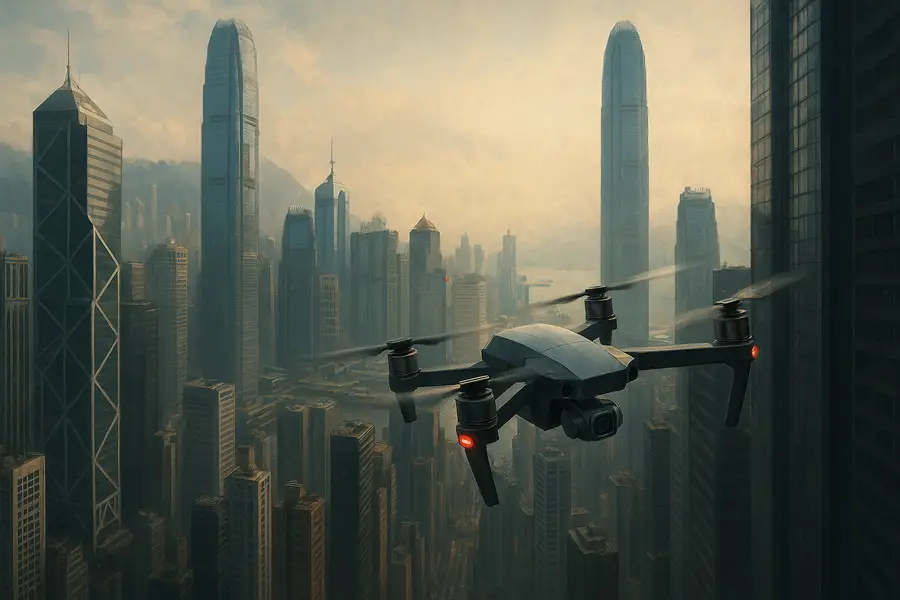
The low-altitude economy’s launch is opening a practical pathway for AI drones as Hong Kong enters a new phase marked by ageing buildings and challenges of managing a vertical city
By Gary Ng
Today’s Hong Kong is entering a pivotal moment in its urban evolution as the low-altitude economy (LAE) shifts from concept to becoming critical infrastructure. As cities worldwide explore new aerial corridors for logistics, inspection, and public safety applications, Hong Kong stands out due to its tightly packed skyline, ageing building stock and rising demand for safer urban operations.
With buildings averaging an age of 34.3 years and 19.2% of those built more than 50 years ago, the city faces increasing pressure to modernize how it inspects, repairs, and manages its vertical infrastructure. This is where the LAE begins to show its transformative potential that supports smarter, faster and safer city management.
Reimagining façade maintenance
For years, façade inspection has relied on such traditional methods as the use of scaffolding, gondolas, and manual visual assessments. While effective, these approaches are increasingly insufficient for a city ageing at scale.
These methods expose workers to fall risks, demand significant time and struggle to keep pace with the inspection frequency required across thousands of towers. Under the Mandatory Building Inspection Subsidy Scheme, every building older than 30 years is required to undergo a mandatory inspection every 10 years. This further increases the complexities of manual façade inspection measures.
AI drones, an initiative under the LAE, is now reshaping this challenge. Their ability to conduct high-resolution façade scans across entire elevations allows engineering teams to detect subtle defects long before they become safety hazards.
For example, in many deployments, autonomous drones can capture high-resolution façade scans of an entire block within a single morning, depending on site constraints and weather conditions. The drone’s onboard edge AI can help identify early-stage cracks around window ledges and areas of moisture seepage that have not yet manifested visibly.
The engineering team can then schedule targeted repairs within days, preventing potential structural deterioration cycles that could escalate into public-safety risks.
Hong Kong’s irregular building geometry creates tight spaces where conventional inspection methods struggle between towers. In the city’s North Point district, for instance, engineers are now overseeing a 25-storey residential redevelopment using AI-driven drones to examine a tight rear elevation that was nearly impossible to access by gondola.
Navigating with AI precision
Such integrated AI technologies in the drones rely on AI-based spatial mapping instead of GPS, using real-time 3D reconstruction to navigate between two buildings, which might be only four metres apart. It can capture façade footage from angles that were previously inaccessible due to human risk constraints.
This level of autonomy is often essential for building a more complete structural record. Continuous data over several flights helps engineers confirm the recurring cracks on the walls from thermal stress, enabling the project team to adapt their material selection for long-term performance.
It demonstrates how the LAE is enabling routine operations that were previously dependent on manual labour and partial visibility.
In dense cities, the future of drone operations is not about flying higher or farther; it is about enabling AI to interpret structural conditions, predict risk patterns, and interact natively with the urban digital ecosystem.
The value of modern technologies like aerial inspections is extending across the built-environment ecosystem. On several ongoing construction sites, contractors are deploying automated drone flight paths to capture weekly progress models. The drones map concrete pours, excavation volumes, and tower-crane zones with precision, feeding data into BIM models that help project managers reconcile discrepancies between design schedules and on-site realities.
This not only reduces industrial disputes but also accelerates measurement workflows and provides objective visuals for safety planning.
Utility operators are also experimenting with drone-based asset-condition tracking, where AI drones can conduct thermal and visual assessments of rooftop transformer units, detecting early overheating in a secondary coil. The issue might have remained unnoticed during standard manual inspections due to its intermittent nature.
Digital twins are another area seeing rapid integration. When drone-captured façade data is integrated into a building’s digital-twin platform, it automatically creates a temporal record to forecast repair budgets over a 10-year cycle. Engineers can now simulate water-seepage progression, thermal expansion stress, and material fatigue, making it easier to plan long-term maintenance rather than relying on reactive repair cycles.
Regulatory momentum drives scalable operations
Underlying these innovations is Hong Kong’s evolving LAE regulatory sandbox established in March 2025. It facilitated the testing of drone applications beyond visual-line-of-sight (BVLOS) flights under the permission of the Civil Aviation Department. For example, Traffic Control Technology (Hong Kong) Company Limited and MTR Corporation are using drones aided with AI technologies for inspecting areas such as railway tracks, stations and buildings.
As the ecosystem matures, new expectations are emerging around data governance, cybersecurity, and interoperability as well. Firms are moving toward encrypted, on-device processing to minimise the movement of raw visual data, with the ability of face and body anonymisation to protect the privacy of workers and residents.
Meanwhile, city-wide drone-ready infrastructure, such as rooftop landing pads and distributed charging nodes, is being explored to support future autonomous fleets that may eventually conduct routine inspections without human pilots.
The advancement of Hong Kong’s LAE is not about replacing traditional inspection techniques but elevating them with enhanced accuracy, repeatability, and operational safety. AI drones provide comprehensive visibility across not only mandatory façade inspections but also in utility assets and construction site safety.
This advanced form of monitoring is faster, more objective, and most essentially less hazardous for frontline workers. These changes signal a broader transformation where aerial intelligence becomes embedded in everyday city management.
Gary Ng is the CEO and co-founder of viAct, with over 10 years of experience driving AI- and automation-led innovation in the construction and industrial sectors. You can reach him at: gary@viact.ai
This commentary is the view of the writer and does not necessarily reflect the views of Bamboo Works
To subscribe to Bamboo Works weekly free newsletter, click here
Related Articles
RELATED ARTICLES
-
With Indian production base taking shape, is BIEL Crystal headed for an IPO?
- Joyson Electronic enters robotic race in bid to soup up its IPO
-
WORK Medical enters strategic partnerships in bid to explore RWA initiatives
WOK.US
- Deltaphone plans Hong Kong IPO amid clearing path to profitability
- Creality builds up three-dimensional IPO with low-cost 3D printer story
- EnjoyGo shifts gears to driverless future on road to IPO