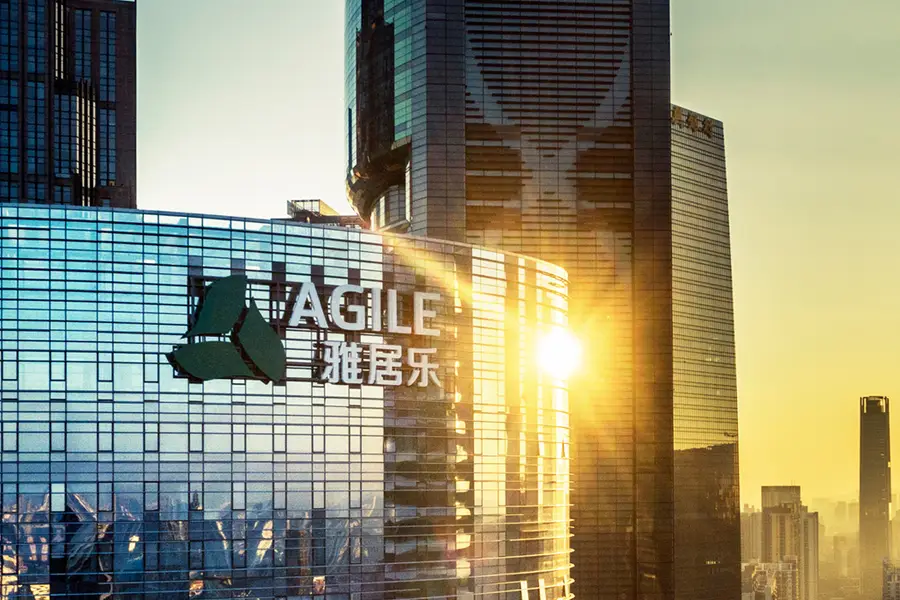
A former partner has requested Agile’s liquidation over an outstanding debt that isn’t substantial, but could still trigger a chain reaction
Key Takeaways:
- Agile Group is facing a liquidation petition filed against it in Hong Kong by a subsidiary of former partner Melco International Development
- The property developer’s average selling price per square meter plunged 32% year-on-year to 9,113 yuan in the first 11 months of this year
Lee Shih Ta
An unfulfilled “cultural tourism dream” could be quickly becoming a nightmare for the debt-heavy Agile Group Holdings Ltd. (3383.HK). The developer’s shares plummeted nearly 20% in intraday trade last Tuesday amid a flurry of market rumors about the company’s welfare. Agile disclosed that evening that one of its creditors was seeking to liquidate the company, further battering already fragile market confidence.
According to its announcement, Melco (Zhongshan) Business Management filed a petition for Agile’s liquidation with the Hong Kong High Court for failure to pay bills totaling $18.59 million and $2.23 million yuan ($317,000). The court has scheduled the first hearing in the case for Feb. 25.
The debt, equal to about $19 million, is a drop in the bucket compared to Agile’s total liabilities, and is also tiny compared to the huge sums that many Chinese property developers are currently struggling to pay their creditors. Still, investors are alarmed that the creditor in this case is Melco International (0200.HK), one of Macao’s licensed casino operators and Agile’s former cultural tourism partner in what was previously hailed as a “powerhouse alliance.”
The partnership dates back to June 2021, when Agile and Melco jointly acquired a large mixed-use site spanning about 504,000 square meters in the Cuiheng New District of the city of Zhongshan, just across the border from Macao, for 3.82 billion yuan. They planned to develop the site as a 10 billion yuan cultural tourism hub featuring a theme park, five-star hotel, shopping mall, medical aesthetics center and luxury apartments.
Project unravels
Under the original agreement, Melco was responsible for developing the theme park, while Agile would handle the rest. Agile was to contribute about 5.65 billion yuan and Melco at least 400 million yuan. Agile later failed to meet its obligations and issued a termination notice in July 2022. While the parties reached a dissolution agreement in 2023, Agile ultimately defaulted on the settlement payments, prompting Melco’s pursuit of legal action.
Agile stated in its announcement that it “strongly opposes” the petition and will continue engaging with its offshore creditors, with whom it is trying to negotiate a comprehensive debt restructuring agreement.
Agile’s liquidity crunch is directly tied to its massive investments in cultural tourism projects in China. Over the past decade, the company bet heavily on an “integrated cultural tourism complex” model that includes projects like the one in Zhongshan. Such projects demand hefty investment, have long development cycles and slow payback periods. They also generate significantly weaker cash flow than simpler residential developments, putting developers under greater financial strain.
In the first half of this year, Agile’s revenue tumbled 35.8% year-on-year to 13.57 billion yuan, while its loss narrowed 17% to 8.03 billion yuan. The bottom-line improvement stemmed largely from one-time measures taken by the company, including selling its condiments business, selling part of its stake in A-Living Smart City Services (3319.HK), laying off roughly 6,000 employees and cutting operating expenses. While such steps helped its bottom line, they don’t signal any fundamental recovery in its core business in China’s struggling property market.
Plunging prices
China’s sluggish property market is offering little support for Agile or the many other developers that once thrived when things were booming. The company’s cumulative presales for the first 11 months of the year sank about 45% year-on-year to 8.08 billion yuan. Though that represents an improvement from the 64.8% slide a year earlier, it still marks a second consecutive year of steep contraction. The company’s sales area in the first 11 months of this year fell by about 20% to 886,000 square meters.
Meanwhile, Agile’s average selling price plunged roughly 32% year-on-year to 9,113 yuan per square meter in the 11-month period, much steeper than the 10.2% decrease a year earlier. The accelerating rate of decline reflects increasingly aggressive price cuts by developers to drive sales as they face intense pressure to reduce their inventory. Still, sales volumes continue to decline, indicating such price cutting is having limited effect.
Agile’s financial statements show the structural risks the company currently faces. Its total liabilities stood at 150 billion yuan at the end of June, down slightly from 155.2 billion yuan at the end of 2024. But the structure of those liabilities remained the same. Its short-term borrowings maturing within one year remained high at 37.87 billion yuan, dwarfing its cash of only 3.09 billion yuan. That leaves the company with an extremely thin cash buffer, enough to cover less than 10% of its short-term debt.
On the asset side, Agile still holds about 29.62 million square meters of land reserves with an average cost of just 2,338 yuan per square meter, theoretically offering some monetization potential. But parts of that land bank are already being used as debt collateral, limiting that potential. Reflecting that, three of its plots at the Hainan Clear Water Bay development were auctioned by tax authorities at a reserve price of about 1.56 billion yuan to settle the company’s tax debts. Agile is also negotiating to sell back some of its completed commercial properties to local governments.
The company hasn’t been idle over the past year. It secured extensions for a combined 14.92 billion yuan in loans, recovered over 1.2 billion yuan in high-risk receivables, divested non-core assets and slashed its costs. Yet such measures only buy the company time, and Melco’s legal action signals that creditor patience is running out.
It often takes just a spark to ignite a debt bomb. Agile stated in September it aimed to reach a preliminary restructuring agreement with its offshore creditors by year-end, already behind its original third-quarter target. With no progress in its offshore debt restructuring and Melco now taking a new legal step, other Chinese partners and creditors could take similar actions, setting off a domino effect. Such a chain reaction could rapidly accelerate, injecting even more uncertainty into the company’s debt resolution process.
To subscribe to Bamboo Works weekly free newsletter, click here
Related Articles
RELATED ARTICLES
-
A-Living gets tough on debt arrears to claw back into profit
 3319.HK
 -
Vanke not out of the woods as losses, debt keep mounting
2202.HK000002.SHE
- BRIEF: Agile’s October sales rise month-on-month, but fall year-on-year
-
China Travel International sheds property unit to focus on core business
0308.HK
- Guo Xin Service makes IPO bid into frigid market for new property plays
-
Will Int’l Entertainment’s billion-dollar gamble finally pay off?
1009.HK