InSilico lands drug discovery deal after Hong Kong IPO
The developer of AI-enabled drugs could get up to $888 million from the new deal but, without any viable products yet, its revenues rely on partner payments
Key Takeaways:
- The company’s Hong Kong IPO late last year attracted pharmaceutical giants, technology titans, sovereign wealth funds and big asset managers, attracted by the promise of accelerated drug development using AI
- InSilico’s core candidate drug for lung disease can boast one of the world’s fastest rates of progress for an AI-powered discovery
By Molly Wen
Fresh from a colossal IPO, AI-assisted pharmacology pioneer InSilico Medicine (3696.HK) is making headlines again, with an international partnership to speed the discovery of new cancer drugs.
The Chinese biotech announced last week thatit had entered into a multi-year research and development deal worth up to $888 million with Servier, an independent pharmaceutical group based in France.
The news came within weeks of InSilico scoring Hong Kong’s biggest IPO of 2025, raising HK$2.28 billion ($290 million) to pursue its mission of using artificial intelligence to accelerate the delivery of novel drugs.
Under the agreement, InSilico’s proprietary AI platform will be used along with Servier’s oncology expertise to come up with new candidate drugs and turn them into marketable products.
In so doing, the collaborators will share the risks and the profits, with InSilico getting up to $32 million in upfront and near-term payments for its AI input, while Servier will co-fund R&D activities. The French partner will take the lead in testing, registering and launching any promising drug formulations that emerge from the relationship.
The deal offers further cause for investor cheer after InSilico’s Dec. 30 main-board listing, priced at HK$24.05 per share, which was oversubscribed more than 1400 times and locked in more than HK$328 billion in capital. It was the highest subscription rate among the healthcare IPOs last year that met the standard financial criteria for a Hong Kong listing and did not need to use an earnings waiver for biotechs.
The reception underscores market confidence in AI drug discovery, reinforced by InSilico’s stellar line-up of cornerstone investors including pharmaceutical titans, technology giants, sovereign wealth funds and prominent asset managers. A total of 15 global institutions – including Eli Lilly, Tencent, Temasek, Schroders, UBS Asset Management, China Asset Management and Taikang Life – committed around $115 million in funds to support InSilico’s drug discovery effort.
Financial pressure
Despite its eminent backers, and the buzz around AI pharma, InSilico still faces business challenges, relying on upfront payments from business development deals until its innovations start to realize their potential and generate product revenue.
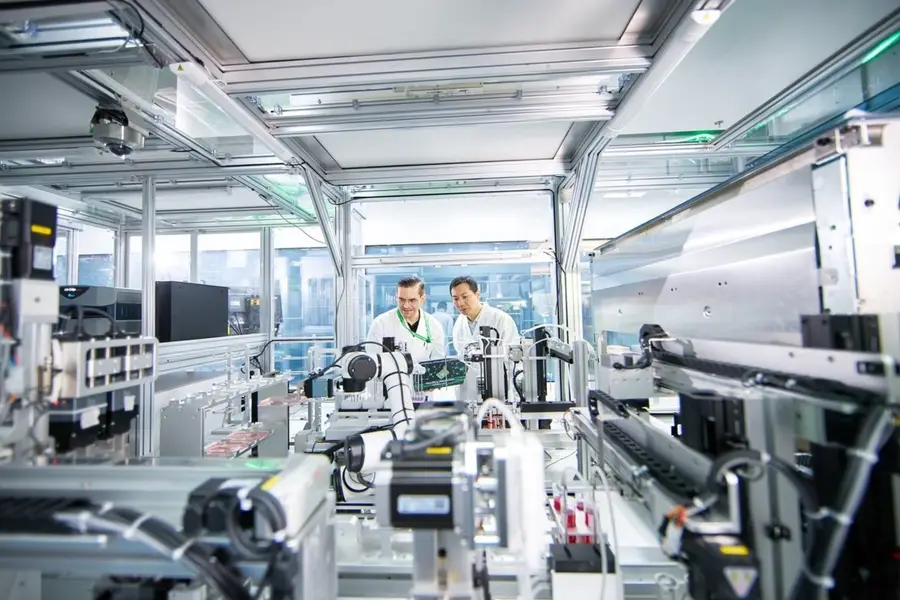
Founded in 2014, InSilico was an early driver of the AI-powered drug industry. AI is used to identify novel targets for new drugs and to engineer corresponding treatments at a faster pace than with conventional technology. The company also develops software solutions and can apply its technology to non-pharmaceutical fields, but drug discovery and development account for roughly 90% of its revenue, anchored by its Pharma.AI platform.
The proprietary technology supports the cycle of drug discovery and development, from identifying promising targets and generating small molecules to predicting clinical outcomes. The company licenses access to its AI platform on a subscription basis, while the technology can also serve industries such as advanced materials, agriculture and nutritional products.
The AI tool can boost the efficiency of early-stage R&D compared with standard drug discovery, according to InSilico data cited in the prospectus. The company said conventional approaches take an average of 4.5 years to progress from target discovery to confirmation of a preclinical candidate, while the timeline shrinks to just 12 to 18 months using the AI platform.
The firm has gained approval for 10 AI-discovered molecules to enter clinical trials, including an experimental drug to treat a severe form of lung disease, idiopathic pulmonary fibrosis, that the company expects to enter Phase Two B and Phase Three trials in China in the first half of 2026. Of AI-engineered experimental drugs produced so far around the world, InSilico’s rentoserib, which targets a protein involved in lung inflammation, is advancing at one of the fastest rates.
InSilico is no stranger to working with international partners. It has clinched licensing deals with U.S. based biotech Exelixis (EXEL.US) and the Italian drug group Menarini, with a combined potential value approaching $2 billion. The company has also established joint R&D activities with major groups including Sanofi, Eli Lilly and Fosun Pharma, as well as discovery partnerships with global drugmakers such as Novo Nordisk, Boehringer Ingelheim and Pfizer. By the middle of 2025, InSilico had worked with 61 customers on drug discovery projects.
Despite the appeal of its business model, InSilico has yet to achieve profitability. Its revenue remains heavily concentrated among a small number of big customers, making earnings highly sensitive to the timing of upfront payments from business development deals. From 2022 to 2024, the company’s revenue grew from $30.1 million to $85.8 million, while net losses shrank sharply from $222 million to $17.1 million over the same period.
However, revenue fell 54% year on year to $27.5 million in the first half of 2025, while net losses widened to $19.2 million, highlighting the volatile revenue stream from partnership transactions.
By the end of the first trading week of 2026, InSilico’s share price had nearly doubled from its IPO level to trade at HK$47, for a market capitalization exceeding HK$26 billion and a price-to-sales ratio of roughly 69 times. By comparison, an AI drug developer that listed in Hong Kong in 2024, XtalPi Holdings (2228.HK), commands a market value of about HK$54 billion and trades at a price-to-sales multiple of around 48 times. Investors appear to be assigning a higher premium to InSilico, reflecting its faster pipeline progress and perceived growth potential as the AI-accelerated drug industry starts to bear fruit.
To subscribe to Bamboo Works weekly free newsletter, click here
Related Articles
RELATED ARTICLES
-
XtalPi scores landmark deal for AI drug discovery
 2228.HK
 - Hong Kong to welcome world-leading siRNA company as Ribo launches its IPO
-
BRIEF: InSilico jumps in Hong Kong trading debut
3696.HK
- BRIEF: InSilico gets CSRC nod for Hong Kong IPO
-
CSPC feels the pain from sweeping cuts in drug prices
1093.HK
- Obesity drug maker Sciwind targets IPO, with heavyweight backers
- Armed with AstraZeneca deal, Eccogene files for Hong Kong IPO