Mens clothier HLA seeks to cast off stagnation with overseas expansion
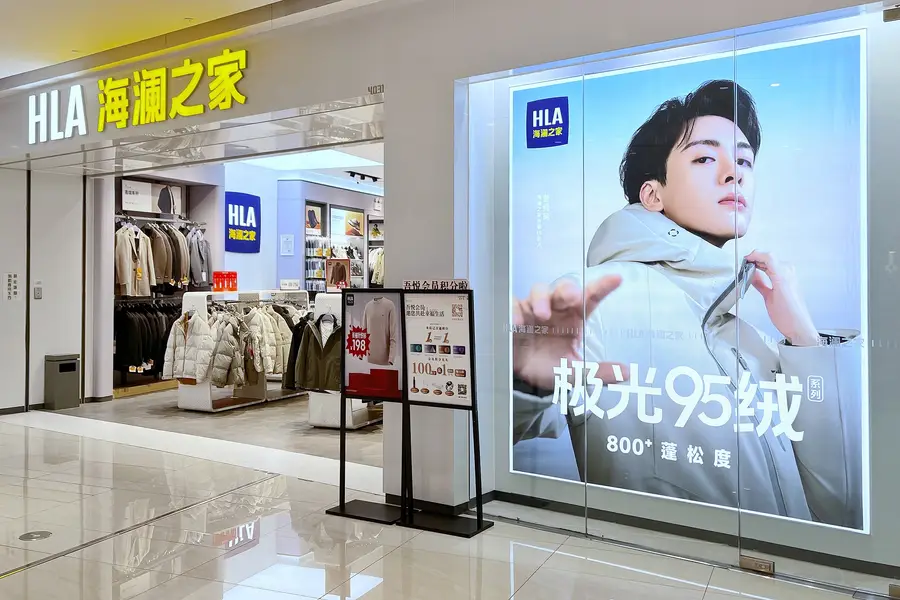
The dominant menswear maker has filed for a Hong Kong listing, seeking funds to expand overseas as its growth at home slows and even contracts
Key Takeaways:
- HLA has filed to list in Hong Kong, reporting its net profit plunged 25% in 2024 as its revenue fell 3%
- The leading men’s clothing maker reported its revenue edged up slightly in the first half of 2025, while its profit continued declining
By Lau Chi Hang
Back when television was still king and a primary vehicle for clothing advertisers, HLA Group Corp. Ltd. (600398.SH) rode to the height of fashion in menswear on its celebrity endorsements and moniker as “The man’s wardrobe.” The brand rapidly ascended to industry leadership through its positioning offering clothing for China’s “everyman.”
Now, the company is hoping to take that everyman appeal to global investors with a planned Hong Kong IPO, as it tries to jumpstart its flagging growth hamstrung by weakness at home, according to its listing document filed with the Hong Kong Stock Exchange late last month.
HLA was the world’s second-largest menswear brand by revenue last year, according to third-party industry data cited in the listing document. It was a giant at home, commanding 5.6% of China’s menswear market, surpassing the combined share of its next four rivals, and was the only menswear brand to generate more than 10 billion yuan ($1.41 billion) in annual revenue.
HLA’s operations are divided into four segments: its proprietary brands, international sports brand cooperations, corporate apparel customization, and urban outlets. Its proprietary brands include its core menswear-focused HLA, the OVV womenswear brand and the infant and children’s wear brand YeeHoO.
Valuation peak
HLA was founded in 1988 by Zhou Jianping, who paid 300,000 yuan to a wool mill in East China’s Jiangsu province to make his first products. A pivotal moment came in 2002 when he traveled to Japan and was deeply impressed by the wide variety, low prices and supermarket-style self-service shopping approach used by local apparel brands. On his return to China, he opened the first HLA store on Zhongshan North Road in Nanjing, capital of Jiangsu. Zhou went on to leverage his keen market sense and marketing skills, including celebrity endorsements and precise positioning, to build HLA into China’s menswear leader.
The company listed on the Shanghai Stock Exchange in December 2000, and saw its market value briefly surpass 100 billion yuan in 2015 on its rapid expansion. But growing competition from online shopping created headwinds for mass-market apparel brands like HLA, and the company’s stock subsequently tumbled from its former heights.
HLA is also suffering from an image problem as fashion trends rapidly change. Despite retaining its market-leading position last year, its styles are being increasingly shunned by younger Gen Z consumers, eroding its reputation as a trendsetter. That prompted the company to branch beyond menswear by expanding into women’s and children’s clothing several years ago.
Revenue, profits slip into reverse
HLA’s latest financials clearly show how the company’s business is stagnating as it gets overtaken by the times. Its revenue sagged nearly 3% year-on-year last year to 20.2 billion yuan, while its profit sank by nearly 25% to 2.19 billion yuan. It returned to revenue growth in the first half of this year, when the figure edged up 3% year-on-year to 11.24 billion yuan. But its profit continued to fall, dipping 3% to 1.59 billion yuan.
Compounding the weak performance, or perhaps reflecting it, the company’s inventory levels remain stubbornly high. Its inventory approached 12 billion yuan last year, up 28% year-on-year. By the end of this September, the figure stood at 11.52 billion yuan, up 12% from the end of June. Concurrently, its trade and bills receivables are also climbing, rising 20% year-on-year to 1.25 billion yuan by the end of last year, and increasing 20% between June and September this year to 1.56 billion yuan by the end of September.
With revenue growth proving elusive and discounting apparently off the table, the company remains heavily reliant on promotion to boost its sales. Its distribution and sales expenses over the past three years have risen steadily from 3.4 billion yuan in 2022 to 4.8 billion yuan last year, and reached nearly 2.5 billion yuan in the first half of this year alone.
In a nutshell, slowing sales have led to ballooning inventory, and receivables have risen in lockstep. To try and jumpstart the business, the company has sharply stepped up its spending on distribution and sales, and its other costs remain difficult to trim.
HLA is also operating in a sluggish overall Chinese apparel market. That market grew just 3.9% annually from 2020 to 2024, and was projected to pick up just slightly to 4.7% from 2025 to 2029, showing apparel is no longer a high-growth market.
Small overseas footprint
With growth slowing in its home China market, HLA has tried to find greener pastures overseas. It kicked off an international strategy several years ago, and now operates over 100 stores in Southeast Asian countries including Malaysia, the Philippines, and Vietnam. It entered Australia in September with its first store opening in Sydney.
If its Hong Kong listing makes it to market, HLA plans to use the proceeds partly to enhance its international brand image and competitiveness. It also plans to use funds for investments and acquisitions, targeting international brands to expand its global sportswear portfolio.
That said, its overseas business currently remains a tiny piece of its overall revenue pie. The figure reached 355 million yuan in 2024, up 30.8% year-on-year, and was up 27.4% year-on-year in the first half of 2025 to 206 million yuan, accounting for less than 3% of the total.
Among Chinese apparel brands listed in Hong Kong, menswear-focused China Lilang (1234.HK) currently trades at a price-to-earnings (P/E) ratio of nearly 9 times. Sportswear leaders Anta (2020.HK) and Li Ning (2331.HK) trade higher at around 14 times, while winterwear specialist Bosideng (3998.HK) trades at a similar level of 15 times. Applying a P/E multiple of 12 times would value HLA at around HK$40 billion ($5.14 billion), about 20% higher than the current value of about 30 billion yuan for its Shanghai-traded shares.
To subscribe to Bamboo Works weekly free newsletter, click here
Related Articles
RELATED ARTICLES
-
Apparel maker Tanboer seeks fashionability from buoyant IPO market
- Seeking a profile boost, Boxihe pivots to Hong Kong IPO
-
Noah finds second life in overseas voyage
6686.HKNOAH.US
-
Brand expansion deflates Topsports’ top, bottom lines
6110.HK
-
Can Proya export its story to become a global makeup artist?
603605.SHG