Eve Energy powers toward Hong Kong IPO, undeterred by price wars
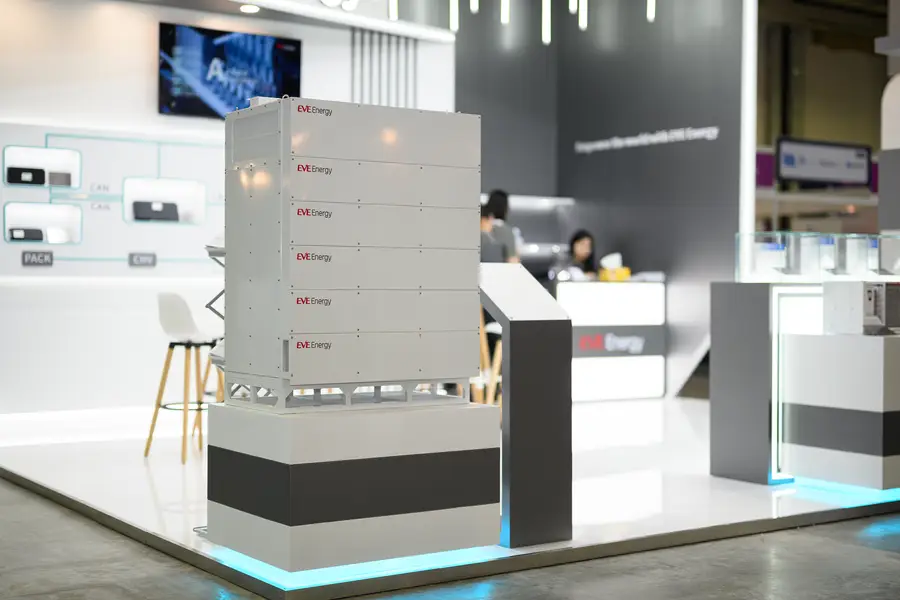
The world’s fifth-ranked EV battery maker is following market leader CATL with plans to complement its Shenzhen listing with a new one in Hong Kong
Key Takeaways:
- Lithium battery maker Eve Energy has filed to list in Hong Kong, pivoting to energy storage products and overseas sales as price wars hit its core EV battery sales in China
- The company has dropped plans for a third phase of its Malaysian factory and is shifting its focus to a new facility in Hungary set to start production in 2027
By Edith Terry
What a difference a half year makes in the fast-moving world of electric vehicles (EVs).
When EV battery giant Eve Energy Co. Ltd. (300014.SZ) first filed to list in Hong Kong last June, investors holding its shares already listed on China’s domestic Shenzhen Stock Exchange barely blinked. But the lithium battery maker got a much warmer reception after re-filing its Hong Kong listing application last week, with its shares rising by 6% in the following days.
The catalyst this time appears to be reviving growth for the company since its last application, as well as one of the hottest Hong Kong IPO markets in years. Investors might also be encouraged by a similar second listing in Hong Kong for Eve’s larger rival CATL (3750.HK; 300750.SZ) last May. Since that listing – Hong Kong’s largest last year, raising $5.3 billion – CATL’s Hong Kong shares have nearly doubled.
Eve Energy’s original Hong Kong IPO application revealed a growth story similar to CATL’s, fueled by a rapid rise of the new energy vehicle (NEV) market, especially in China. Since its original Shenzhen filing in 2009, the company’s revenues and profits have averaged annual growth of 43.9% and 36.4%, respectively, according to its latest listing document.
But the company hit a speed bump in 2024, with revenue actually falling slightly that year to 48.6 billion yuan ($7 billion) from 48.8 billion yuan a year earlier. Things have improved since then, at least on the top line, with the company’s revenue rising 32% year-on-year to 45 billion yuan in the first nine months of 2025. But its profit for that period declined by 9.1% year-over-year to 2.9 million yuan, showing the company still faces some headwinds.
Eve Energy is a major player on the EV battery scene, though its Shenzhen market cap of 144 billion yuan is less than a tenth of the 1.7 trillion yuan for CATL. Still, a successful IPO this time would put Eve Energy in the same class as CATL as the only Chinese battery makers with dual listings in Shenzhen and Hong Kong, even though nine out of 10 of the world’s top EV battery makers are Chinese.
When Eve Energy filed its initial prospectus last June, it was reportedly aiming to raise around HK$30 billion ($3.85 billion). But the world has changed since then and so has Eve Energy. For one thing, the company has dropped plans to build a third phase of its factory in Malaysia, which was originally set to be a major recipient of proceeds from its Hong Kong IPO.
Instead, it now plans to use those proceeds to focus on a 30 GWh factory in Debrecin, Hungary for next-generation EV batteries for the European market. While this may look like a sign of confidence, Eve’s battery business has had a rocky time over the past few years due to intensifying competition and generally rising prices for lithium, a core component of today’s most leading-edge products.
Four major cathode manufacturers recently stopped production for a month as apparent pushback to rising lithium prices, according to Chinese media. In another form of pushback, CATL declared at a supplier conference last year that it was aiming for a mass deployment of sodium-ion batteries, which use much cheaper and more environmentally friendly sodium-ion technology, to reduce its dependence on lithium.
Three main segments
Although its core technologies are based on lithium, Eve Energy has an advantage over some of its peers in making batteries not only for EVs but also for energy storage systems. It also has a major presence in consumer-use batteries, which is where company founder Liu Jincheng got his start.
With a degree in chemistry, Liu left his job at a power plant to start his own business in 1994. His first venture failed, but his second, Huizhou Jinda Electronics fared better, targeting batteries for personal handy phones, an early type of mobile phone, as well as vapes, electronic toll collection, and earphones. Later renamed Eve Energy, the company made its move into power batteries for EVs and energy storage in 2015.
Eve Energy spends heavily on R&D, accounting for 2.9 billion yuan, or 6.1% of total revenue in 2024. It has seven research institutes and an R&D workforce over 6,000.
Such investments and its years of experience have helped Eve Energy achieve its current position as one of the top three consumer battery makers globally, with 11.7% of the market by shipment volume, according to independent research in the prospectus. It is among the top five Chinese manufacturers of EV-use power batteries, with 2.8% of the global market in 2024, and the second largest energy storage battery supplier globally, with 17.2% of the market.
In the first nine months of last year, consumer batteries accounted for 8.26 billion yuan in revenue, or 18.3% of Eve’s total; power batteries brought in 19.6 billion yuan, or 43.6%; and storage batteries brought in 17.1 billion yuan, or 37.9% of total revenue.
The biggest challenge for Eve Energy and its peers in the last few years has been chaos in the crowded EV battery industry. Falling prices due to intensifying competition caused Eve Energy’s average selling price to plunge by nearly half from 1.1 billion yuan per GWh in 2022 to 600 million yuan per GWh in the first nine months of 2025.
The company is trying to turn down the heat on its power battery business both by revving up its energy storage battery business, and also selling more overseas where competition is less fierce. Overseas sales accounted for 23.4% of its revenue in the first nine months of 2025, mostly to South Korea and the EU. The Hungary factory, due to start producing in 2027, is key to the success of boosting its overseas sales, together with the existing Malaysia factory.
Its big lifesaver could be energy storage batteries, which rose from 26% of revenue in 2022 to the latest figure of 37.9% last year, driven by surging construction of renewable energy power stations that require electricity storage systems. The International Energy Agency forecast 2025 storage battery sales of $66 billion, up 16% over 2024, with Chinese companies taking all the six top spots in terms of suppliers.
While energy storage batteries have strong potential, we should point out they still carry the lowest gross margin of 11.2% among Eve Energy’s three main product segments. By comparison, EV batteries had a gross margin of 15.3%, while consumer batteries were the highest at 26.8%.
To subscribe to Bamboo Works weekly free newsletter, click here
Related Articles
RELATED ARTICLES
-
Tinci Materials eyes Hong Kong listing, hoping investors see past its sagging profits
 002709.SHE
 - In EV battery race, Sunwoda boasts edge with profitable consumer business
-
Lithium price slump: the ghost that keeps haunting Ganfeng Lithium
1772.HK002460.SHE
- Guoxia Tech banks on AI for energy storage boost
-
Sungrow powers up to meet soaring demand from AI data centers
300274.SHE
-
Can dead batteries deliver a profit boost for recycler GEM?
002340.SHE
- NEWS WRAP: Hithium likely to continue Hong Kong IPO process after initial application