
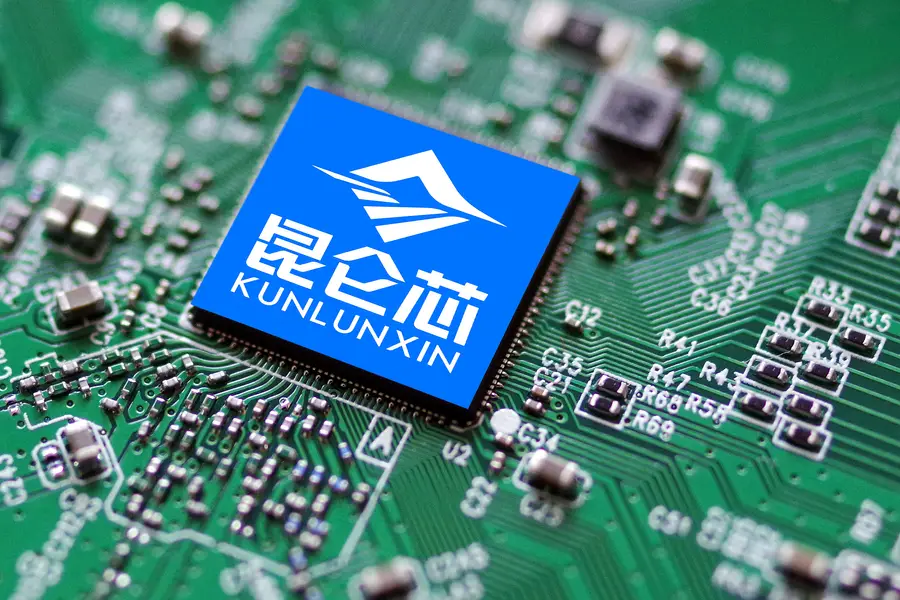
The search giant and AI aspirant is considering a possible separate listing for its Kunlunxin chip unit, seeking a slice of a market currently led by Nvidia
Key Takeaways:
- Baidu says it is considering a listing for its Kunlunxin chip unit, which hopes to challenge AI chipmakers like Nvidia
- The company is expected to generate revenue of 3.5 billion yuan to as much as 5 billion yuan this year
By Lau Chi Hang
Baidu Inc. (9888.HK, BIDU.US) was an early giant on China’s internet scene, canonized in that position as the “B” of the “BAT” triumvirate that also included Alibaba and Tencent. But that was a decade ago, and since then the company has been eclipsed by newer rising tech firms like smartphone maker Xiaomi, takeout delivery leader Meituan, and e-commerce and logistics giant JD.com, making the BAT acronym increasingly an anachronism.
Baidu founder Robin Li has naturally taken matters into his own hands, and aggressively pursued a rebirth for his company with a laser focus on AI, led by heavy bets on its Apollo autonomous driving initiative. Yet those efforts have failed to provide much lift for Baidu’s stock – until this month, that is.
A Reuters report saying Baidu planned to spin off and separately list its chip-making unit, Kunlunxin (Beijing) Technology Co. Ltd., sent its shares soaring nearly 6% that day – adding more than $2 billion to its market value. The company later clarified it is assessing a potential spinoff and listing, and there is no assurance that such moves will follow.
So, why did Kunlunxin make such a splash for Baidu? Its credentials are noteworthy. Originally Baidu’s in-house intelligent chip and architecture department, Kunlunxin began developing its own chips as early as 2011. Baidu first unveiled the unit publicly in 2018 and spun it off as an independent entity three years later. Ouyang Jian, Baidu’s chief chip architect, became CEO. Its valuation hit 13 billion yuan ($1.84 billion) in its first funding round, equal to nearly 5% of Baidu’s latest market cap of about $40 billion.
Things move quickly in the fast-paced world of chip development. After launching its first-generation Kunlunxin chip in 2021, the company rolled out a second generation two years later. It leveraged those in subsequent releases of its K100 accelerator card and RH800 server, and this year debuted a third-generation P800 chip.
Fast-rising sales
Backed by Baidu’s technical resources and its own R&D, Kunlunxin has grown rapidly in terms of sales. The company ranked second in sales of data center AI accelerator cards in China last year, with nearly 70,000 units shipped, according to IDC. That made it second, albeit a distant second, to Nvidia (NVDA.US), which led the field with over 1.9 million units shipped.
Beyond supplying Baidu, Kunlunxin also generates significant revenue from outside sources, including a 1 billion yuan order from leading wireless carrier China Mobile in August this year. Reuters reported Kunlunxin’s revenue reached 2 billion yuan last year, as the company booked a net loss of 200 million yuan. Its revenue is projected to rise to 3.5 billion yuan this year, with the company expected to break even, according to company investor materials cited in the Reuters report. Guosen Securities believes Kunlunxin’s revenue could hit an even higher 5 billion yuan this year and breach the 10 billion yuan threshold next year.
Such rapid growth would certainly inject some buzz back into Baidu’s financials. The company’s latest report showed its revenue fell 7% year-on-year and 4.7% quarter-on-quarter to 31.17 billion yuan in the third quarter. At the same time, long-term asset impairments pushed Baidu into the red with a net loss of 11.2 billion yuan. Even after excluding those charges, its profit of 2.6 billion yuan was down 66% from 7.6 billion yuan a year earlier.
Revenue from “Baidu core,” the company’s main business providing advertising and marketing services, fell 7% year-on-year to 24.7 billion yuan for the quarter, as online marketing revenue fell by an even bigger 18% to 15.3 billion yuan. Non-online marketing sales performed better, up 21% to 9.3 billion yuan, while revenue for its iQiyi (IQ.US) online video unit fell 8% year-on-year to 6.7 billion yuan.
Rising star in chips
Compared with those numbers, Kunlunxin’s revenue is showing some impressive growth, including the possibility of profitability next year. U.S. technology restrictions and sanctions on chips have spurred Beijing to offer its nonstop support – both in policy and also financially – for domestic chip R&D, helping to catalyze an entire industry.
The feeding frenzy has created a similar euphoria among investors, particularly for AI-related chip plays, many of them relatively young. Cambricon (688256.SH) boasts a market cap of more than 500 billion yuan. And the money-losing Moore Threads (688795.SH) leveraged its status as China’s answer to Nvidia to notch remarkable gains in its Shanghai trading debut earlier this month. The company’s stock rose more than fivefold to 600 yuan from the 114.28 yuan IPO price on its first trading day, valuing it at 300 billion yuan and netting some tidy gains for investors lucky enough to get their hands on IPO shares.
Cambricon’s steady gains and Moore Threads’ explosive rally reflect investor exuberance for chip stocks – a sentiment that looks likely to continue for at least a while. Backed by Baidu’s formidable resources and advanced technical support, Kunlunxin’s surging revenue and imminent profitability could create similar excitement if it ultimately decides to list. That could deliver a much-needed shot in the arm for Baidu’s stock, signaling potential upside.
Accelerating Apollo Go
Beyond Kunlunxin, Baidu’s higher-profile Apollo Go autonomous ride-hailing unit is also showing signs of gaining momentum after years of development. Robin Li recently stated that self-driving technology has “crossed that critical threshold.”
The threshold Li refers to is safety, a key factor holding back wider acceptance of the technology. Apollo Go says it averages one airbag deployment incident per 10.14 million kilometers, surpassing the human driving average. The service currently operates in 22 cities globally, handling over 250,000 weekly orders. It has logged more than 140 million kilometers in fully driverless mode and completed over 17 million rides, gradually advancing toward commercialization.
Though still losing money, Apollo Go may be another potent engine that could finally bring some excitement back to Baidu’s stock. Such a renaissance could spark a rebirth for the “BAT” moniker as well, since Tencent and Alibaba have retained their places as China’s two most valuable internet companies.
To subscribe to Bamboo Works weekly free newsletter, click here
Related Articles
RELATED ARTICLES
-
BRIEF: Baidu’s Apollo Go tops global robotaxi market with 14 million rides and global advances
-
Reborn Unisplendour trades in chips for digits
000938.SHE
- Moore Threads taps China IPO investors as it faces challenges, opportunities
-
Longsys nears Hong Kong listing with key regulatory green light
301308.SHE
-
Will new investor Goldstream bring its Midas touch to Saint Bella?
1328.HK2508.HK
-
Huaqin rides data center boom to Hong Kong IPO
603296.SHG
- Yangtze Memory overhauls share structure in preparation for IPO


