Galaxis hitches ride on Hong Kong robotics bandwagon
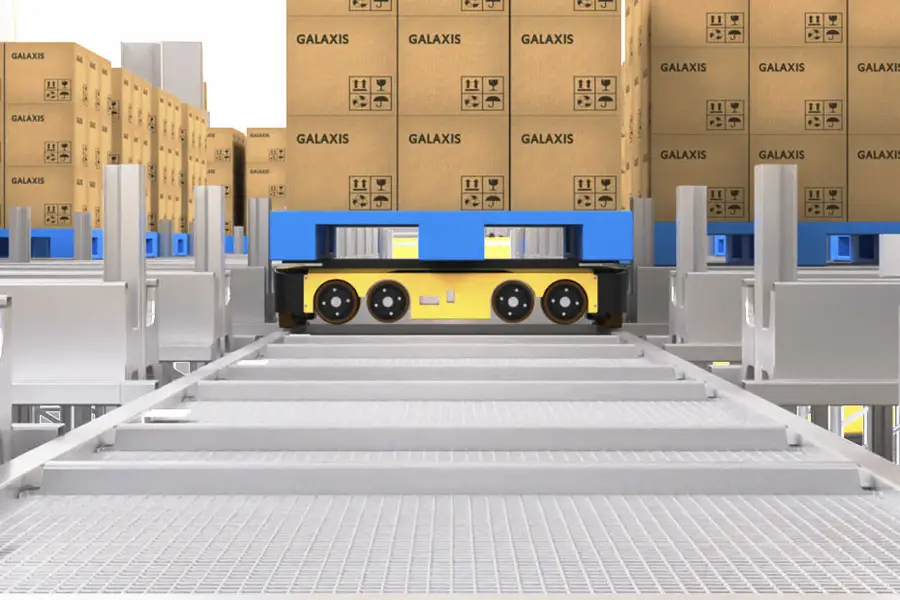
The intralogistics robotics specialist has filed for an IPO, adding its name to a growing list of robot concept stocks
Key Takeaways:
- Galaxis Technology has filed for a Hong Kong IPO, reporting its revenue surged by over 60% in the first nine months of last year
- The company ranks fifth in China’s fragmented sector for logistics robots, but continues to report big losses
By Bai Xin Rui
The AI explosion has affected just about every industry imaginable, as companies across the spectrum rush to strut their artificial intelligence credentials. In that crush of information, one sector with a stronger case for the technology is robotics, which is using AI to create a new generation of intelligent, autonomous robots. A growing number of manufacturers in that space are now looking to capital markets to fund their costly growth, including Zhejiang Galaxis Technology Group Co. Ltd., which this month applied to list in a Hong Kong market that has embraced such concept stocks.
Galaxis was established in 2016 by two science geeks. One, Gu Chunguang, holds a PhD from the Massachusetts Institute of Technology (MIT) and previously served as Chief Technology Officer for Shanghai-listed Jointown Pharmaceutical. The other, Yang Yan, also holds a PhD in electrical engineering from Cornell University, and formerly worked at global chip giant Infineon’s China unit.
Gu is currently Galaxis’ chairman and controls about 40.3% of the company’s shares, while Yang is deputy general manager. The company boasts a deep pool of other major backers, including two funds under leading Chinese investment bank CICC, as well as logistics giant S.F. Holding, China Merchants Group and Gu’s former employer, Jointown Pharma.
The intralogistics area that’s Galaxis’ specialty refers to the movement, storage, retrieval and management of materials and goods within warehouses, distribution centers and factories. By 2024, the global intralogistics market was worth a hefty 2.3 trillion yuan ($329.1 billion).
Historically centered on manual labor, intralogistics is undergoing a fundamental shift toward comprehensive intelligence made possible by AI applications, improving hardware capabilities, internet of things (IoT) technology and integrated software systems. The emergence of robotics, in particular, has substantially boosted efficiency in many core intralogistics functions, including storage, retrieval, sorting and transportation, across a wide spectrum of application scenarios. The transformation is simultaneously driving down labor costs while also boosting accuracy and efficiency.
Fragmented industry
The global market for intelligent intralogistics robotics is growing rapidly, fueled by escalating corporate demand for logistics efficiency and automation, according to third-party research in Galaxis’ prospectus. The market expanded from 42.6 billion yuan in 2020 to 118.3 billion yuan in 2024, with China accounting for 37.2% of the total, and is projected to reach 344.1 billion yuan by 2030.
Around 100 firms currently operate in China’s intelligent intralogistics robotics sector, showing the market remains highly fragmented. Reflecting that, Galaxis commands a tiny 1.6% share of the market, which is still enough to rank it fifth domestically. Similarly, the industry leader holds just 4.6% of the market. The top five players combined hold just 12.6%, showing the market could be ripe for consolidation.
Galaxis produces three core product types: multi-directional shuttle robots (MSRs), autonomous mobile robots (AMRs), and conveying and sorting robots (CSRs). Among its shuttle robots, which specialize in handling containers and pallets, its four-way shuttle robots offer the greatest flexibility thanks to their ability to move in any direction: forward, backward, left and right. Those robots’ compact dimensions and high maneuverability make them highly effective for high-density inventory processing within rack systems.
The company’s AMRs, characterized by their high precision and efficiency, can readily adapt to high-density storage environments. Their ability to interface with floor-level containers and pallets and execute lifting operations is suitable for accessing and transporting bins and pallets. Meanwhile, the company’s CSRs utilize mechanical arms and sorting mechanisms to rapidly distribute items into designated channels, facilitating high-precision, uninterrupted 24-hour operations for such functions.
Galaxis is growing rapidly as more logistics companies make the switch from manual to robotic operations. Its revenue rose 60.3% year-on-year to 552 million yuan in the first nine months of 2025, with 92.5% of sales generated in China. Its largest contributor was multi-function comprehensive systems, involving self-developed robots integrated with third-party products to address multiple operational needs, which accounted for 73.3% of its total. Sales from single-function robot deployments followed with 24.8% of the total.
Red ink flow
As its revenue has boomed, Galaxis’ gross profit reached 91.4 million yuan in the first nine months of 2025, up 51.8% year-on-year. Within that figure, gross profit from its multi-function comprehensive systems business surged 129% to 49 million yuan, accounting for 53.6% of the total. The gross margin for the segment increased by 2.8 percentage points year-on-year to 12.1% in the latest reporting period. However, a significant decline from after-sales services and other segments caused the company’s overall gross margin to fall by 0.9 percentage points year-on-year to 16.6%.
Galaxis continues to lose money, including a 135 million yuan loss in the first nine months of 2025, similar to its loss a year earlier. The ongoing losses owe primarily to rising expenses in sales and marketing, administration, and R&D. Administrative expenses saw a particularly sharp increase of 33.2% year-on-year to 56.9 million yuan in the first nine months of last year, largely driven by costs associated with IPO preparations.
Still, the company’s future potential looks good due to a global penetration rate estimated at only about 20.5% in 2025 for intralogistics robots. Galaxis’ accelerating overseas expansion could help to ease some of its losses, and it’s also noteworthy that the recent surge in administrative expenses is mostly due to the IPO, a one-time event. That could mean the company’s chances of achieving profitability in the foreseeable future are reasonably good.
A good benchmark for Galaxis could be Geekplus (2590.HK), another Hong Kong-listed company that’s a leader in AMR, and currently trades at a price-to-sales (P/S) ratio of 10.6 times based on estimated revenue of more than 3 billion yuan last year. Galaxis’ probable revenue for last year is far smaller, likely well below 1 billion yuan, meaning such a high multiple may be unrealistic. Accordingly, any attempt to achieve such a high valuation multiple could ultimately dampen demand for the stock, even in Hong Kong’s current hot market for new robot listings.
To subscribe to Bamboo Works weekly free newsletter, click here
Related Articles